On the fertilizer production line, how to efficiently and gently turn caked raw materials into uniform fine powder is a key technology. The cage crusher (also known as a cage mill) is precisely the ingenious equipment designed for this task. Unlike traditional hammer mills that rely on brute force, it achieves thorough grinding through clever “multiple collisions.”
Core Structure: Two Cages Rotating in Opposite Directions
The core design of the cage crusher is highly ingenious. It mainly consists of two concentrically installed “cages”—an inner cage and an outer cage. Each cage resembles a rotating wheel equipped with multiple layers of hard alloy rods (called cage pins). Most crucially, these two cages are driven by a motor to rotate at high speed in opposite directions. This is the secret to its efficient crushing.
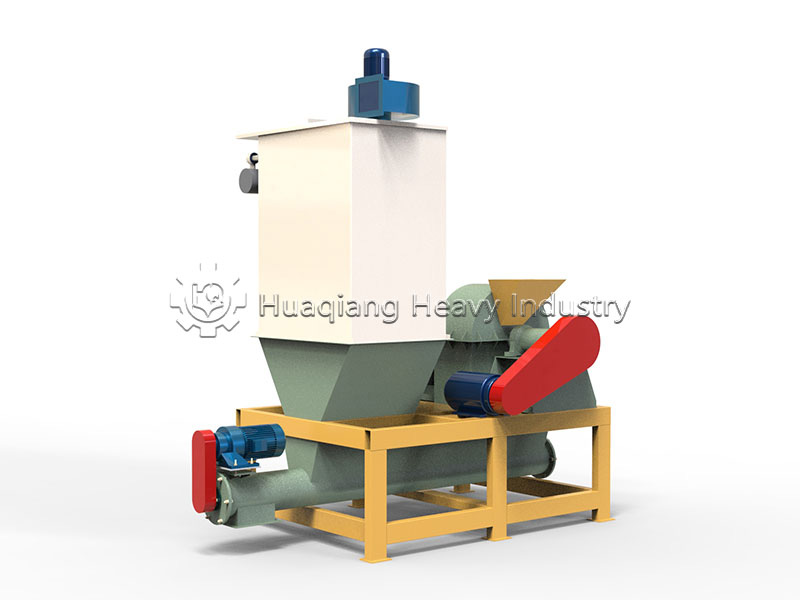
Four-Step Grinding: A Precisely Designed Collision Journey
The material’s journey inside the machine is an efficient multi-stage grinding process:
Feeding: Caked organic fertilizer or large fertilizer granules are fed from the top inlet, dropping into the center of the high-speed rotating inner cage.
Primary Crushing (Collision with the Inner Cage): The material is immediately struck violently by the cage pins on the inner cage, breaking large chunks into smaller fragments for the first time. Simultaneously, the centrifugal force generated by the high-speed rotation flings these fragments outward at extremely high speed, directly toward the outer cage.
Fine Crushing (Reverse Collision and Inter-Particle Collision): This is the most remarkable part. The outward-projecting fragments collide head-on with the cage pins of the outer cage, which is rotating in the opposite direction at high speed. This “head-on collision” creates a tremendous relative speed and shearing force, further refining the material.
Furthermore, some particles rebounding after hitting the outer cage or the machine housing will collide violently with other particles still flying outward. This “inter-particle collision” significantly increases grinding efficiency while reducing direct wear on the cage pins.
Screening and Discharge: A screen is located at the bottom of the crushing chamber. Only fine powder that meets the required particle size can pass through the screen holes and be discharged as the finished product. Oversized particles remain in the chamber to continue this collision journey until they meet the standard.
Unique Advantages: Gentle, Uniform, and Efficient
This unique working principle gives the cage crusher irreplaceable advantages:
Multi-Stage Gentle Grinding: It doesn’t rely on a single heavy blow but uses accumulated energy from multiple collisions to break the material. This method generates less heat, effectively protecting heat-sensitive nutrients (like nitrogen) in organic fertilizers from loss due to high temperatures.
Uniform Particle Size, Low Over-Grinding: The final particle size is precisely controlled by the bottom screen, effectively preventing the production of excessive ultra-fine powder. This makes it especially suitable for fertilizer granulation processes that require uniform particle size.
Strong Adaptability: It can handle both medium-hard chemical fertilizer return materials and damp, caked organic fertilizer. It is particularly adept at processing brittle and slightly fibrous materials.
Relatively Low Wear: Since “inter-particle collision” handles a large part of the grinding work, the wear on the cage pins themselves is reduced, leading to a longer service life and lower maintenance costs.
From Size Reduction to Granulation: A Complete Organic Workflow
The cage crusher serves as a critical pre-processing unit within a comprehensive suite of fertilizer production machine equipment. Its gentle, multi-stage grinding is essential for preparing uniform raw materials for the subsequent organic fertilizer fermentation process. Efficient decomposition during this phase is achieved through advanced fermentation composting turning technology, implemented with specialized fertilizer making machine equipment such as the trough-type compost turner, large wheel compost turner, or chain compost turner.
Following complete stabilization, the matured compost, now part of the equipments required for biofertilizer production, proceeds to the final shaping stage. This is typically accomplished using a disc granulation production line, which transforms the finely ground and fermented organic matter into uniform, market-ready pellets. This integrated workflow—from gentle size reduction and optimized biological decomposition to precision granulation—demonstrates the synergy between different specialized machines to efficiently convert organic waste into high-value, effective soil amendments.
Conclusion
The cage crusher is like an artist skilled in “Tai Chi.” It transforms direct impact into clever multiple collisions, decomposing fertilizer raw materials just right with lower energy consumption and a gentler approach. In modern chemical and organic fertilizer production, which emphasizes nutrient preservation and particle size control, its efficiency, uniformity, and gentleness make it one of the key pieces of equipment ensuring quality in the pre-processing stage. It guarantees that every particle of raw material enters the granulation phase in optimal condition, laying a solid foundation for the final production of high-quality fertilizer products.