The combination of a cage crusher and a cyclone dust collector is a golden combination for the pretreatment of raw materials in fertilizer production. It achieves both fine crushing of large raw materials and efficient dust collection, purifying the production environment. It is widely applicable to the processing of raw materials for various fertilizers, including organic fertilizers and compound fertilizers, and is especially suitable for large-scale production scenarios requiring strict dust pollution control.
Core Equipment Functions and Synergistic Advantages
Cage Crusher: The Core Equipment for Precise Raw Material Crushing
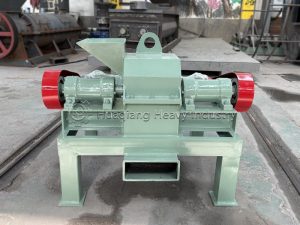
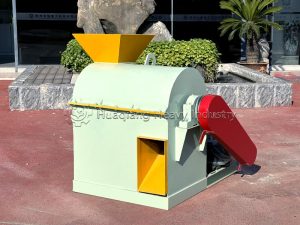
Working Principle: Utilizing a “double-cage rotor collision + shearing” crushing mode, the inner and outer cage bars are driven by a motor to rotate at high speed (speed up to 1500-2000 r/min). After entering the chamber, the raw material is rapidly crushed through impact, shearing, and mutual collision between the cage bars. The particle size after crushing can be flexibly controlled between 0.5-3 mm.
Suitable Raw Materials: Perfectly processes inorganic fertilizer raw materials such as urea, monoammonium phosphate, and potassium chloride, as well as organic raw materials such as fermented livestock and poultry manure, straw charcoal, and mushroom residue. It can crush large materials with a particle size ≤80mm, with a crushing efficiency of 5-15 tons/hour (adjusted according to machine specifications).
Core Advantages: The cage bars are made of high-chromium wear-resistant alloy material, achieving a hardness of HRC60 or higher after quenching treatment, extending the service life to over 8000 hours; the equipment has a built-in grading screen, which can be replaced with different mesh sizes to ensure uniform output particle size; compact structure and low operating noise (≤75dB), suitable for compact production line layouts.
Cyclone Dust Collector: An Environmentally Friendly Solution for High-Efficiency Dust Purification

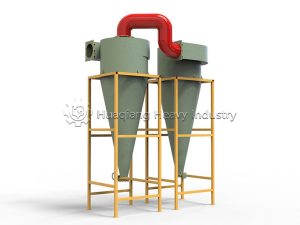
Working Principle: Utilizing centrifugal force to separate dust, dust-laden gas enters the dust collector chamber at high speed through the inlet, rotating along the inner wall. Dust particles are thrown against the wall by centrifugal force and slide down the cone wall to be collected in the ash hopper. The purified gas is discharged from the outlet, achieving a dust removal efficiency of 95%-98%.
Suitable Scenarios: Specifically designed for collecting dust generated during the operation of cage pulverizers, especially for dust particles with a diameter of 0.1-10μm in fertilizer production. It can control the dust concentration in the workshop to below 10mg/m³, meeting national environmental protection standards.
Core Advantages: Made of carbon steel or stainless steel, corrosion-resistant and easy to maintain; no need for filter cloths or other easily damaged parts, resulting in low operating costs; large air volume handling capacity (1000-5000m³/h), precisely matched to the dust generation of cage pulverizers, and can be directly connected to a fan for negative pressure dust removal.
III. Collaborative Workflow and Value
After the raw materials are crushed by the cage crusher, the resulting dust-laden gas is drawn into a cyclone dust collector under the negative pressure of a fan.
The dust is efficiently separated and collected, and the purified gas is discharged in compliance with standards. The collected dust is discharged through the ash hopper and can be recycled back to the production line for reuse, increasing material utilization by 3%-5%.
The entire system achieves integrated “crushing + dust removal” operations, ensuring that the raw material fineness meets standards, solving the dust pollution problem, reducing material waste, and lowering production losses.
Selection and Usage Precautions
Selection and Matching Key Points
Capacity Matching: Based on the hourly output of the cage crusher (e.g., 5 tons/hour, 10 tons/hour), select a cyclone dust collector with a corresponding air volume to ensure dust removal efficiency and avoid dust leakage due to insufficient air volume;
Material Compatibility: When handling corrosive raw materials (e.g., ammonium sulfate, monoammonium phosphate), the equipment should be made of stainless steel or have an anti-corrosion coating to extend its service life;
Installation Height: Sufficient installation height (usually ≥3 meters) should be reserved for the cyclone dust collector to ensure that dust settles smoothly into the ash hopper and avoids accumulation and blockage.
Daily Use and Maintenance Regularly check the wear of the cage bars in the cage crusher; replace them promptly if severely worn to avoid affecting crushing efficiency. Clean the screen regularly to prevent material from clogging the screen holes. Clean the dust collected in the cyclone dust collector’s hopper regularly to prevent excessive dust accumulation from affecting the dust removal effect. Check the air inlet and outlet for leaks to prevent a decrease in dust removal efficiency. Maintain the matching fan regularly to ensure stable negative pressure. Adjust the fan speed according to the amount of dust generated to balance dust removal efficiency and energy consumption.
A Foundational Step in the Production Chain
The cage crusher and cyclone dust collector system represents a critical early-stage process within a complete organic fertilizer manufacturing system. It ensures that raw organic materials are properly sized and cleaned before entering the core biological and shaping stages, setting the stage for high-quality final product manufacturing.
This preprocessing step is integral to an efficient organic fertilizer manufacturing operation. The crushed and cleaned material, often derived from compost processed by a chain compost turning machine using advanced fermentation composting turning technology, is ready for the organic fertilizer production granulation stage. Here, manufacturers can choose specialized equipment to shape the material. Options include a dedicated organic fertilizer disc granulation production line featuring an organic fertilizer disc granulation machine for uniform pellets, or a versatile organic fertilizer combined granulation production line that may incorporate a new type organic fertilizer granulator. This systematic integration, from efficient crushing to precise granulation, defines a modern, high-output organic fertilizer production line.Therefore, the value of the crushing and dust removal system extends far beyond its immediate function; it is an essential enabler of consistency, efficiency, and environmental compliance throughout the entire organic fertilizer production process.