Against the backdrop of the booming organic fertilizer industry, more and more farms and startups are investing in building small-scale organic fertilizer production lines. For these lines with a capacity of 1-5 tons/hour, maximizing efficiency within a limited investment budget is the most pressing concern for investors. Based on practical experience from over 170 successful projects, Huaqiang Heavy Industry has summarized a set of effective cost optimization solutions.
Equipment Selection: The First Step to Cost-Effective Planning
Equipment investment is the largest expenditure item in production line construction. Reasonable equipment selection can significantly reduce initial investment. For small production lines with a daily processing capacity of around 10 tons, a modular design concept is recommended, avoiding the pursuit of large and complex equipment.
Taking the mixing stage as an example, a 1.5-ton/hour twin-shaft paddle mixer paired with a 2-ton/hour new two-in-one granulator can meet basic production needs. In the drying stage, small production lines can make full use of natural conditions, using natural drying in a sun-drying area instead of drying equipment, saving more than 30% of equipment investment. At the same time, prioritizing cost-effective domestic equipment is also a wise choice. Domestically produced equipment is not only 50%-70% cheaper than imported products, but also has advantages in spare parts supply and maintenance services, effectively reducing later operating costs.
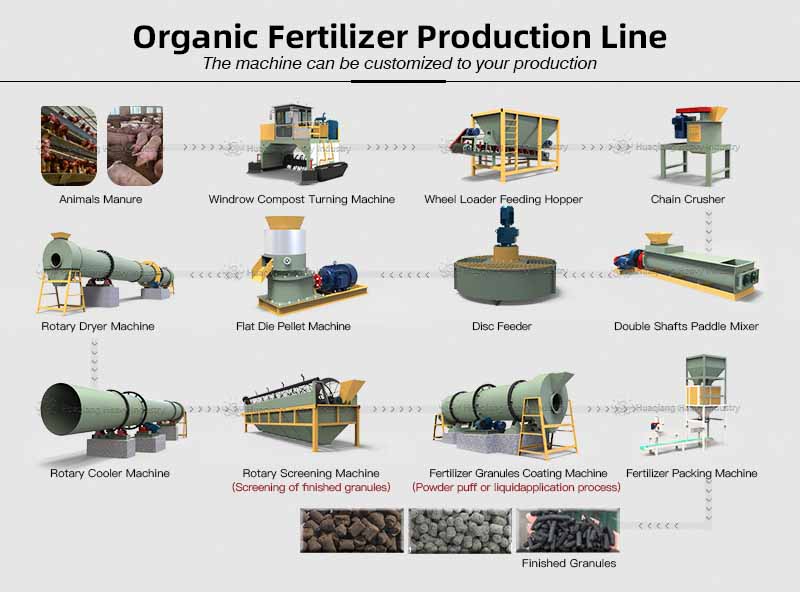
Process Flow: The Wisdom of Simplification
Simplifying the production process is another effective way to control costs. Small production lines can adopt a streamlined process route of “pretreatment-fermentation-granulation-screening-packaging,” reducing unnecessary intermediate steps and equipment configurations.
In the raw material pretreatment stage, agricultural waste such as straw and sawdust are used as auxiliary materials, which can adjust the carbon-nitrogen ratio and replace expensive commercial binders. The fermentation stage combines natural fermentation with microbial fermentation, significantly reducing the amount of microbial agents used while ensuring fermentation quality. During granulation, precisely controlling the raw material moisture content between 25%-35% can effectively reduce the amount of binder used, saving 50-80 yuan per ton of product.
It is particularly important to note that different regional climate conditions have a significant impact on the fermentation process. In dry areas, the natural fermentation time can be appropriately extended, while in humid areas, ventilation measures need to be strengthened. This localized process adjustment allows for maximum cost savings while ensuring product quality.
Raw Material Procurement: A Key Aspect of Cost Control
Raw material costs typically account for over 60% of the total cost of organic fertilizer production, making optimized raw material procurement strategies crucial. Establishing long-term, stable partnerships with local farms and gaining price advantages through bulk purchasing is an effective way to reduce raw material costs. Some farms are even willing to provide livestock manure free of charge to solve their waste disposal problems.
Recycling agricultural waste not only reduces raw material costs but may also qualify for government environmental subsidies. The collection costs of auxiliary materials such as straw, rice husks, and mushroom residue are far lower than those of commercial auxiliary materials, and with proper proportioning, they can fully meet production requirements. One small organic fertilizer plant successfully reduced its raw material costs by 25% by signing long-term agreements with three surrounding farms and establishing an agricultural waste recycling network.
Operations Management: A Guarantee for Continuous Optimization
The daily operations management of the production line also offers opportunities for cost optimization. Establishing standardized equipment maintenance systems and regularly inspecting and maintaining key equipment can effectively extend equipment lifespan and reduce maintenance costs. Refined management during the production process, such as accurately recording various consumption data and promptly identifying and resolving leaks and waste, can also lead to considerable cost savings.
Personnel training is equally crucial. Skilled operators can better master equipment performance, improve production efficiency, and reduce raw material waste. A small enterprise using a Huaqiang Heavy Industry production line increased its product qualification rate from 85% to 93% and reduced its raw material loss rate by 2 percentage points through systematic employee training.
Economic Benefit Analysis: After implementing the above optimization measures, the economic benefits of small-scale organic fertilizer production lines have significantly improved. Taking a 3-ton/hour production line as an example, equipment selection optimization can save 200,000-300,000 yuan in investment, process optimization can reduce production costs by 15-20%, and raw material procurement strategy optimization can further save costs by 10-15%. Overall, the unit product cost can be reduced by about 20%, and the investment payback period is shortened from the conventional 3 years to 2 years.
Sustainable Development Recommendations: Cost optimization should not come at the expense of product quality. While controlling costs, it is essential to ensure that products meet national organic fertilizer standards to establish a good market reputation and achieve sustainable development. It is recommended that small businesses establish detailed production and quality control standards from the initial construction phase and strictly implement them throughout the production process.
As production scales up and the market changes, cost optimization needs to be continuous. Regularly assessing the cost structure of each stage and identifying new areas for optimization is crucial for businesses to maintain a competitive edge in the market. Huaqiang Heavy Industry’s professional team can provide continuous technical support and services to help clients develop steadily in an ever-changing market environment.
Technological Synergy for Cost-Effective Production
The streamlined process hinges on the strategic integration of key fertilizer production machine technology. Following the optimized organic fertilizer fermentation process—which can be efficiently scaled using a windrow composting machine for economical aeration—the fermented material is ready for shaping. For small-scale operations prioritizing spherical granules, a disc granulator for shaping is a core component of a simplified disc granulation production line. This setup forms the heart of a cost-effective organic fertilizer manufacturing system, transforming well-fermented organic matter into uniform pellets without excessive complexity. For producers aiming for higher-density flakes or dealing with drier materials, integrating a fertilizer compaction machine (or roller press) offers an alternative, energy-efficient granulation path within the same organic fertilizer disc granulation production line framework, providing product versatility. Collectively, the mixer, composter, granulator, and screener constitute the essential equipments required for biofertilizer production. This modular approach allows for phased investment, starting with core fermentation and granulation modules, and scaling up by adding drying, cooling, and coating units as demand grows, ensuring maximum efficiency and flexibility within a constrained budget.