In the field of organic waste treatment, selecting the appropriate compost turner is crucial for efficiently producing high-quality organic fertilizer. Proper equipment selection not only enhances work efficiency but also significantly improves compost quality and extends equipment service life. This article provides comprehensive selection guidance based on material characteristics, processing scale, and application scenarios.
Material Characteristics Determine Equipment Selection
Material moisture content is the primary consideration in equipment selection. For materials with ideal moisture content between 55-65%, all types of compost turners can perform well. However, when handling viscous materials with moisture content exceeding 70%, crawler-type turners become the best choice due to their excellent anti-sinking and anti-adhesion design. Conversely, when processing dry, loose materials, self-propelled equipment with dust covers can effectively control dust issues.
Material particle size and composition are equally important. When processing unshredded straw or caked manure, trough-type turners with strong crushing capabilities are required. Materials containing large amounts of impurities need self-propelled equipment that is easy to clean and maintain. For high-fiber materials, the anti-winding design of spiral turners ensures continuous and stable operation.
Matching Processing Scale with Equipment Power
Material density and daily processing capacity directly determine the required equipment power. Small livestock farms processing loose straw materials can meet their needs with 50-80 horsepower self-propelled turners. Large organic fertilizer plants processing high-density mixed materials require 150-200 horsepower large trough-type turners to ensure production efficiency.
Particular attention should be paid to handling corrosive or high-viscosity materials. In addition to selecting the appropriate equipment type, corrosion resistance of materials and anti-adhesion design must be considered. Stainless steel materials and special coatings can significantly extend equipment service life under harsh working conditions.
Scenario-based Selection Case Analysis
For small to medium-sized livestock farms, self-propelled wheeled turners are ideal due to their mobility and operational simplicity. This equipment can adapt to the working environment of open composting sites, with a single operator capable of completing daily processing tasks of 150-300 cubic meters.
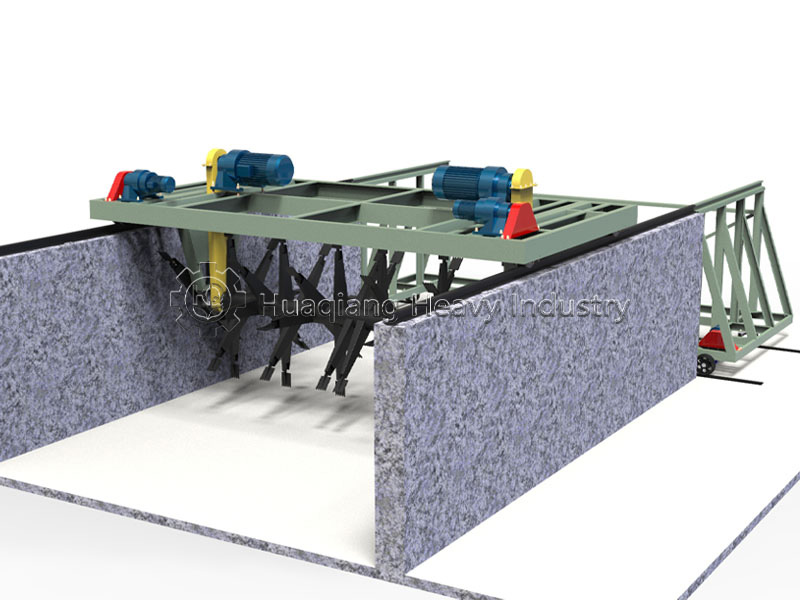
Large-scale organic fertilizer plants are more suitable for trough-type turners. This equipment can form a complete production line with fermentation tanks and spray systems, achieving daily processing capacity of 800-1000 cubic meters, ensuring stability in large-scale continuous production. Environmental treatment stations dealing with high-moisture, high-viscosity food waste and sludge benefit significantly from the anti-sinking and anti-adhesion characteristics of crawler turners.
Selection Considerations
During equipment selection, avoid the situation of “using small equipment for heavy tasks.” When material density is high and moisture content is elevated, choose equipment with 10-20% power redundancy to prevent overload. Simultaneously, site conditions are important considerations – open sites require highly mobile equipment, while fixed production lines prioritize stability.
The durability and maintenance convenience of wear parts should not be overlooked. When materials contain impurities or are corrosive, selecting equipment with replaceable wear parts and corrosion-resistant materials can significantly reduce long-term operating costs. Additionally, auxiliary equipment functions such as spray systems and drainage devices should be considered according to specific material characteristics.
Comprehensive Benefits of Scientific Selection
Through scientific equipment selection, not only can the fermentation cycle be shortened by 30-50%, but the humus content of organic fertilizer can also be increased by 15-20%. Proper equipment selection ensures the uniformity and efficiency of turning operations, laying a solid foundation for producing high-quality organic fertilizer. Meanwhile, well-matched equipment and working conditions can significantly extend equipment service life, reduce maintenance costs, and achieve dual improvement in economic and environmental benefits.
With the continuous development of composting technology, equipment manufacturers are constantly optimizing product designs. In the future, intelligent and automated turning equipment will further enhance the precision and efficiency of compost production, providing more powerful technical support for global organic waste resource utilization
Integrated Systems for Efficient Organic Fertilizer Manufacturing
Scientific compost turner selection forms the foundation of efficient organic fertilizer fermentation process systems. Advanced fermentation composting turning technology employs specialized equipment like the trough-type compost turner, hydraulic trough compost turner, and large wheel compost turner for large-scale operations, while the chain compost turner handles challenging materials. These essential equipments required for biofertilizer production work in harmony with pre-processing systems like the multiple silos single weigh static batching system to ensure precise raw material formulation.
The complete fermentation composting technology for organic fertilizer integrates turning equipment with downstream processing systems. Following complete maturation, materials proceed to a disc granulation production line where the disc granulator transforms fermented organic matter into uniform, market-ready granules. This integrated approach—from precise raw material batching through optimized fermentation to final granulation—creates a seamless production workflow that maximizes resource utilization while producing high-quality organic fertilizers. The synergy between advanced turning technologies and precision processing equipment enables efficient conversion of diverse organic waste streams into valuable soil amendments, supporting sustainable agricultural practices through improved soil health and reduced environmental impact.