In modern composting production, the working efficiency of compost turners directly affects both the production cost of organic fertilizer and product quality. To fully utilize the performance of compost turners, four key factors need comprehensive consideration: equipment performance, material characteristics, operational techniques, and environmental conditions.
Equipment Performance: Foundation of Efficiency
The design parameters of compost turners are decisive factors for their working efficiency. The power configuration of equipment directly determines processing capacity – small self-propelled turners can handle 100-300 cubic meters daily, while large trough-type turners can process 500-1000 cubic meters of material. The design of turning components is equally important, with proper blade shape, quantity, and rotation speed ensuring thorough material breakup and mixing.
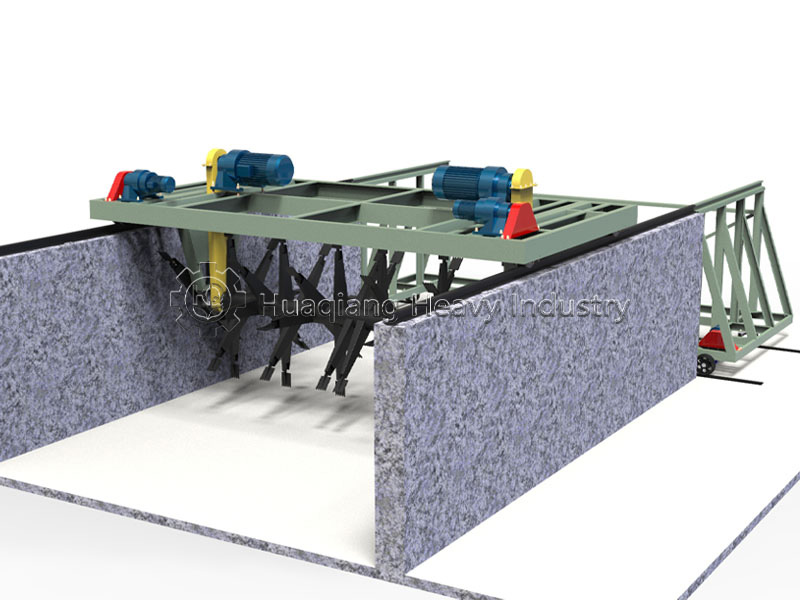
Different types of compost turners suit different working scenarios. Self-propelled and crawler-type equipment offer strong mobility, suitable for open composting sites; trough-type turners, while limited in mobility, demonstrate excellent stability in large-scale fixed production lines. Choosing equipment equipped with spray systems and microbial agent addition devices can further enhance overall operational efficiency.
Material Characteristics: Affecting Operation Difficulty
The physical and chemical characteristics of materials directly influence the operational effectiveness of compost turners. Ideal material moisture content should be maintained between 55-60% – excessively high moisture causes material adhesion, increasing turning resistance; too low moisture easily generates dust, affecting microbial activity. Material particle size is also crucial, with clumps exceeding 10 centimeters significantly impacting turning uniformity.
Pile density and height need to match equipment performance. Overly dense piles significantly increase equipment load, while unreasonable pile height leads to incomplete turning. Additionally, maintaining an ideal carbon to nitrogen ratio of 25-30 is key to ensuring microbial activity, directly affecting fermentation speed.
Operational Techniques: Key to Efficiency Improvement
Scientific operational methods are important for efficiency enhancement. During the initial fermentation stage, daily turning frequency ensures adequate oxygen supply; in the middle and later stages, turning frequency can be appropriately reduced to every 2-3 days. Controlling operational speed is equally important, typically recommended between 0.8-1.2 kilometers per hour.
Adequate pretreatment can significantly improve operational efficiency. Crushing materials to below 5 centimeters, removing impurities, and adjusting appropriate moisture content and carbon to nitrogen ratio can reduce turning resistance by over 30%. Meanwhile, reasonable operational path planning and supporting facility improvement can effectively enhance overall work efficiency.
Environmental Conditions: Factors Not to Be Overlooked
Ambient temperature significantly impacts compost turner efficiency. 15-35°C is the most suitable working temperature range – temperatures that are too low can cause material freezing, increasing turning difficulty; excessively high temperatures accelerate water evaporation, requiring frequent water replenishment. Site conditions are equally important, with level ground and good ventilation creating ideal working environments for equipment.
During winter operations, building insulated sheds can effectively maintain pile temperature; summer operations require timely water supplementation. Ground hardening treatment and adequate operational space reservation are important measures to enhance equipment operational stability.
Efficiency Optimization: A Systematic Project
Improving compost turner efficiency is a systematic project requiring careful planning starting from equipment selection. Choosing equipment that matches production scale, conducting thorough material pretreatment, developing scientific operational plans, and creating good working environments – these measures working together can achieve maximum efficiency.
By comprehensively optimizing these factors, not only can the fermentation cycle be shortened from the traditional 3-6 months to 15-45 days, but organic fertilizer product quality can also be significantly improved, achieving scaled and efficient composting production, thereby providing strong support for sustainable agricultural development.
Integrated Systems for Efficient Organic Fertilizer Manufacturing
Optimizing compost turner efficiency is a cornerstone of effective trough-type aerobic fermentation composting technology and broader fermentation composting turning technology. The selection of specialized equipment, such as the trough-type compost turner for controlled environments, the large wheel compost turner for large windrows, or the chain compost turner for tough materials, directly impacts the organic fertilizer fermentation process. These machines, along with essential pre-composting processing equipment, form the core equipments required for biofertilizer production.
For a complete production system, efficiency begins even before composting. A multiple silos single weigh static batching system can ensure precise raw material ratios. Following optimized fermentation, the stabilized compost proceeds to the final shaping stage. This is where fertilizer granulation technology is applied, often utilizing a disc granulation production line to transform the organic matter into uniform, market-ready pellets. The synergy between advanced turning technologies, precision batching, and modern granulation creates a seamless and efficient workflow for producing high-quality organic and bio-fertilizers at scale.