In modern agricultural production, solid granular fertilizers, with their stable physical form and excellent adaptability, have become the most widely used fertilizer category. They are not only carriers of nutrients but also key media for achieving efficient, large-scale agricultural operations. From vast wheat fields to precise orchard management, these uniformly shaped granules support global grain and vegetable production with their unique advantages.
Classification by Form: Size and Structure Define Function
Solid granular fertilizers are not all the same; their particle size and internal structure determine different uses and effects.
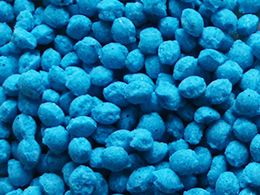
1. Large-Granule Fertilizers
This is the most common form, such as the familiar urea, diammonium phosphate (DAP), and general compound fertilizers. Their granules typically have a diameter of 2-4 mm and are firm and dense. This design makes them resistant to breakage, moisture absorption, and caking, with even nutrient distribution. The advantage of large granules lies in their “longevity.” They dissolve relatively slowly and are primarily used as base fertilizers, deeply incorporated into the soil to provide a stable supply of basic nutrients throughout the crop’s growing season, while also reducing losses from rainwater leaching.
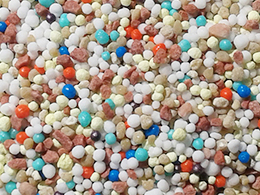
2. Small-Granule / Bulk Blended (BB) Fertilizers
These fertilizers have smaller particle sizes (1-2 mm) and are physically blended from single-nutrient granules (e.g., white nitrogen granules, red potassium granules) in specific ratios, hence the name “BB fertilizers.” Their core advantage is formulation flexibility. Growers can customize the N-P-K ratio according to the needs of different crops and growth stages. They can be used both as base fertilizers and for mechanized precision top-dressing, making them an ideal choice for variable rate application and nutrient management.
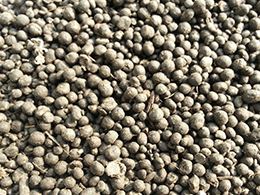
3. Coated Granular Fertilizers
This represents an advanced product of fertilizer technology, such as polymer-coated urea or sulfur-coated urea (SCU). By coating a regular fertilizer granule with a functional membrane (sulfur, polymer, etc.), they achieve precise control over the nutrient release rate. The thickness of this “coat” determines whether nutrients are released slowly over weeks or months. These fertilizers are mainly applied once as a base fertilizer, achieving “one-time application, full-season supply,” greatly saving labor and significantly improving nutrient use efficiency while reducing environmental pollution risks.
Core Advantages: Why is the Granular Form So Popular?
The widespread adoption of solid granular fertilizers stems from their comprehensive advantages:
Excellent Physical Stability: The compact granular form makes them less prone to moisture absorption and caking, resulting in minimal loss during long-distance transport and storage, a long shelf life, and suitability for large-scale warehousing and trade.
Perfect Compatibility with Mechanization: The uniform particle size is the “perfect partner” for modern agricultural machinery. They can be accurately broadcast or placed by seeders and fertilizer applicators, enabling combined seeding and fertilizing, drastically improving operational efficiency and reducing labor costs, especially on large-scale flat farms.
Flexible Application Methods: Whether it’s base fertilizer requiring deep incorporation or precision side-dressing for top-dressing, the granular form is up to the task. From broadcasting and banding to hole application, it covers almost all scenarios, from field crops to horticultural crops.
Controllable Nutrient Release: By adjusting granule size or adding coatings, the dissolution rate of the fertilizer in the soil can be scientifically regulated. This allows the nutrient release curve to better match the crop’s uptake pattern, avoiding the drawbacks of quick-release fertilizers (a sudden burst followed by insufficiency) and achieving more sustained and efficient nourishment.
Scientific Application: The Art of Method and Placement
Correct application methods are key to realizing the efficacy of granular fertilizers, distinguishing between base and top-dressing:
Base Fertilizer Application: The goal is “deep and even.” Common methods include broadcasting followed by plowing (evenly spreading fertilizer on the soil surface and then plowing it into the 15-20 cm soil layer) or banding (placing fertilizer in a trench beside the planting row). For fruit trees, hole application is used, placing fertilizer in the root concentration zone.
Top-Dressing Application: The core principle is “close but avoid roots.” Common methods include side-dressing or furrow application, where a shallow trench is dug beside the crop roots, fertilizer is placed, and then covered with soil. This makes nutrients accessible to the roots while preventing direct contact that could cause “fertilizer burn.” For fruit trees, top-dressing is often done by digging holes near the “drip line” at the outer edge of the canopy projection.
Key Considerations
Match the Type to the Purpose: Large granules are suitable for deep placement as base fertilizer; small granules/BB fertilizers are suitable for shallow placement as top-dressing; coated fertilizers must never be crushed, as this completely destroys their controlled-release function.
Always Incorporate into Soil: Especially for ammonium-based nitrogen fertilizers like urea, if broadcast without timely incorporation or soil cover, nitrogen will volatilize into the air in large quantities, causing waste and pollution.
Maintain a Safe Distance: When top-dressing, fertilizer should be placed in the active root zone to the side, maintaining a distance of 5-10 cm from the plant to avoid direct contact.
In summary, solid granular fertilizers are an indispensable part of the modern agricultural production system. With their standardization, ease of use, and efficiency, they closely integrate nutrient management with modern agricultural technology, providing a solid material foundation for ensuring global food security and the sustainable development of agriculture.
From Powder to Pellet: The Engineering of Modern Fertilizer
The diverse forms and precise characteristics of solid granular fertilizers are the direct result of advanced fertilizer granulation technology. These fertilizer granulation processes are executed by specialized professional fertilizer manufacturing equipment. The choice of technology is crucial. For many standard NPK blends, wet granulation using a rotary drum granulator is common, often integrated into a disc granulation production line for shaping uniform pellets. This method is a core part of the standard npk manufacturing process.
In contrast, the production of dense, slow-release granules often relies on dry fertilizer granules compaction, utilizing a fertilizer compaction machine as the core of a roller press granulator production line. This highlights the engineering precision behind the scenes: each fertilizer type—from basic granules to sophisticated coated products—is manufactured using a tailored granulation pathway. This sophisticated industrial foundation ensures that farmers worldwide receive reliable, high-performance fertilizers that are perfectly suited for mechanized application and precise soil management, ultimately supporting efficient and sustainable agricultural systems.