With the development of organic agriculture and increasing environmental protection requirements, the demand for large-scale organic waste composting is growing. The selection of a compost turner directly impacts production efficiency, compost quality, and operating costs. Currently, the mainstream compost turners on the market are mainly divided into three categories: bridge-type turners, trough-type turners, and crawler/forklift-type turners. Each type of equipment has significant differences in structural design, functional characteristics, and operating efficiency, making them suitable for different production scales, site conditions, and material types. Scientific selection requires considering various factors such as production scale, site size, and material characteristics to maximize equipment efficiency.
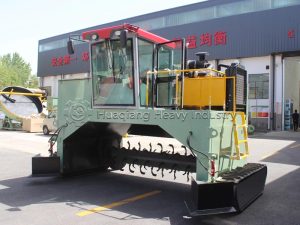
Bridge-type compost turners are currently the most widely used type, primarily designed for large-scale open windrow composting operations, suitable for large organic fertilizer production enterprises and centralized agricultural waste treatment centers. Their core advantages are high operating efficiency and strong maneuverability. The machine adopts a bridge-type structure, allowing it to directly travel and operate on long windrows without the need for additional tracks or trenches. The equipment is equipped with a high-power engine and a rotating drum with adjustable speed. The hammers on the drum are made of wear-resistant alloy material, with a service life of over 5000 hours, and can easily handle various materials such as manure, straw, and oil palm empty fruit bunches. The working width of a bridge-type compost turner is usually 3-6 meters, and the working depth is 0.8-1.5 meters, processing 60-100 cubic meters of material per hour, suitable for large-scale production with an annual processing capacity of over 50,000 tons. In addition, it has a high degree of intelligence and can be equipped with GPS positioning and remote monitoring systems to record operating trajectories and monitor equipment status in real time, reducing operation and maintenance costs. However, this equipment has high site requirements, requiring a flat and open working area, and is not suitable for materials with high viscosity or excessive moisture content.
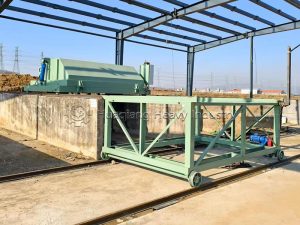
Trough-type compost turners use enclosed trenches as the working platform and are suitable for medium-sized organic fertilizer production enterprises and large-scale farms with high environmental protection requirements. The trough-type compost turner features a structure where composting materials are placed in fixed fermentation trenches. A turning machine moves along a track above the trenches, with a rotating drum extending into the trenches to turn the materials. Forced aeration is provided through ventilation pipes at the bottom of the trenches. This enclosed operation effectively controls the diffusion of foul-smelling gases, and the exhaust gases can be collected and treated centrally, making it more environmentally friendly than open-air operations. Trough-type compost turners offer strong operational stability, unaffected by external weather conditions, and can operate normally even in rainy weather. The materials ferment in layers within the trenches, resulting in more uniform mixing during turning, and improving fermentation efficiency by approximately 20% compared to bridge-type compost turners. Its working width is typically 2-4 meters, working depth 1-1.8 meters, and processing capacity is 30-60 cubic meters per hour, suitable for production scales of 20,000-50,000 tons per year. However, this equipment requires a higher initial investment due to the need to construct fermentation trenches and a track system, and its operational flexibility is limited, unable to adapt to different pile widths.
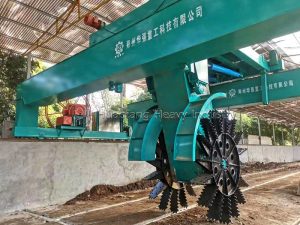
Tracked/forklift-type compost turners prioritize flexibility, making them suitable for small-scale operations such as small farms, family farms, and small and medium-sized livestock farms. Their body uses a tracked or wheeled design, providing a large ground contact area, allowing them to operate on uneven terrain and even muddy surfaces, with no limitations on the working radius. The equipment is compact, easy to operate, and requires no professional operators, allowing for quick learning. Some models can be equipped with interchangeable working parts, enabling both turning and material transfer functions, offering multi-purpose use. Tracked compost turners have a working width of 1.5-3 meters, a working depth of 0.5-1 meter, and a processing capacity of 10-30 cubic meters per hour, suitable for production scales of less than 20,000 tons per year. Their initial investment is lower, and maintenance costs are simple, making them ideal for small users with limited funds and dispersed sites. However, this equipment has lower operational efficiency and cannot meet the needs of large-scale production, and the energy consumption is relatively high when processing large quantities of materials. In summary, the selection of a composting turning machine should follow the principles of “scale matching, site suitability, and material compatibility”: large-scale production should prioritize bridge-type turning machines; medium-sized production with high environmental requirements and limited space can choose trough-type turning machines; and small-scale, decentralized operations are suitable for crawler-type/forklift-type turning machines. At the same time, factors such as energy consumption, maintenance costs, and level of automation should also be considered to achieve efficient processing of organic waste and stable production of high-quality organic fertilizer.
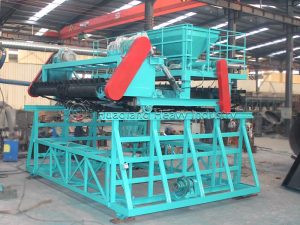
Selecting the Right Tool for Efficient Organic Fermentation
In summary, the strategic selection of a compost turner is the critical first step in establishing an efficient organic fertilizer fermentation process. The choice between a windrow compost turner for open fields, a trough-type compost turner or hydraulic trough compost turner for controlled environments, a flexible self propelled compost production machine, or specialized equipment like a double screws compost turning machine or a large wheel compost turner directly determines the efficiency, uniformity, and speed of the composting phase.
This turning equipment embodies the core of modern fermentation composting technology for organic fertilizer, serving as a primary agriculture waste compost fermentation machine. The high-quality, stable compost it produces is the fundamental raw material for all downstream processing. It forms the initial and most vital link in the chain of equipments required for biofertilizer production. Following successful fermentation, the mature compost can be further refined and shaped into a market-ready product using a disc granulation production line, completing the transformation from raw organic waste to a valuable, standardized soil amendment. Each piece of technology, from turning to granulation, is an integral component in a complete organic fertilizer manufacturing system.
Therefore, investing in the appropriate turning technology is not merely a purchase of equipment but an investment in the entire foundation of a productive and sustainable organic fertilizer operation.