In August 2026, Zhengzhou Huaqiang Heavy Industry Technology Co., Ltd. successfully completed the installation and commissioning of its customized extrusion granulation + drying integrated production line for its Pakistani client, officially entering the stage of large-scale mass production. This production line innovatively integrates the core processes of extrusion granulation and low-temperature drying. Addressing the high-temperature and dry climate characteristics of Pakistan and the stringent moisture control requirements of fertilizer production, it features a closed-loop design of efficient granulation and precise drying, achieving one-stop processing from raw materials to finished products. This provides local fertilizer companies with a customized solution that combines capacity and quality, helping to improve fertilizer storage stability and field application effectiveness.
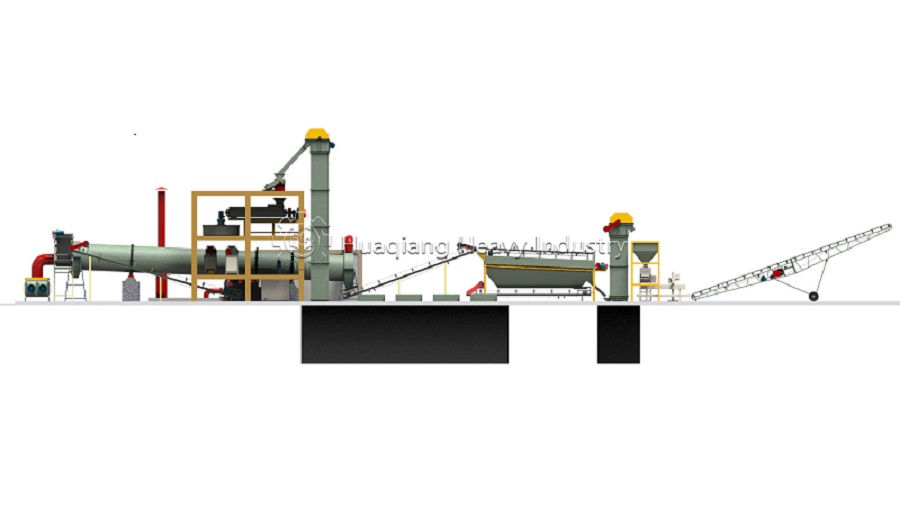
Production Line Configuration and Core Process Analysis
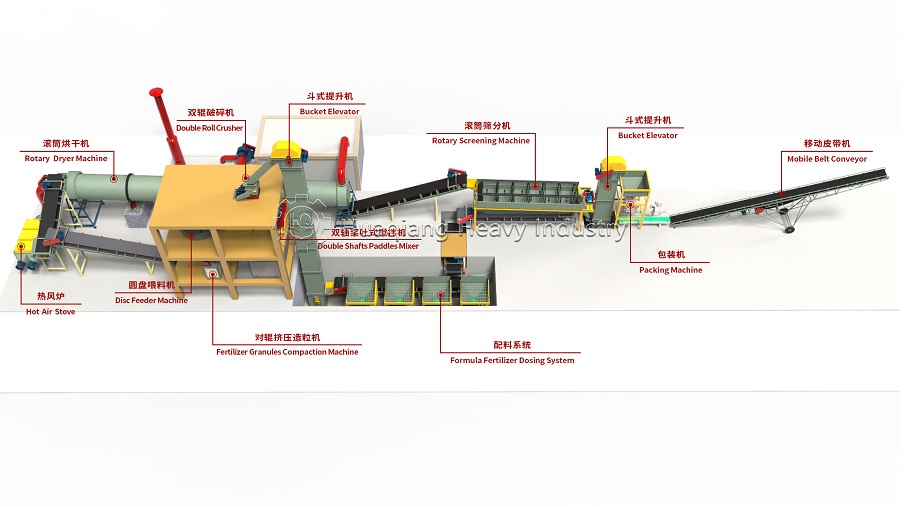
The entire production line is built around the core logic of “raw material pretreatment – extrusion granulation – low-temperature drying – finished product output.” Equipment selection is tailored to regional conditions, and the processes are tightly and efficiently integrated, ensuring both high granulation rate and product quality upgrades through precise humidity control.
Raw Material Pretreatment and Extrusion Granulation Unit: Laying a Solid Foundation for Forming
Raw Material Refinement: The production line starts with a large-capacity loader feeding hopper, adapting to the rapid feeding needs of bulk raw materials. The feed inlet is equipped with spill prevention and impurity filtration devices to reduce raw material loss and equipment failure risks. Raw materials are transferred via a conveyor system to a 60-type crusher (presumably a “60-type horizontal semi-wet material crusher”). This equipment adopts a two-stage crushing structure, with a high-chromium wear-resistant alloy cutter disc, capable of crushing large, agglomerated raw materials (particle size ≤80mm) into uniform fine materials ≤3mm, achieving a crushing efficiency of 4 tons/hour, providing a high-quality raw material foundation for subsequent granulation. The crushed raw materials are then fed into a twin-shaft mixer via a belt conveyor, where they are thoroughly mixed by counter-rotating blades, with a mixing uniformity error ≤2%, ensuring balanced fertilizer nutrients.
High-efficiency extrusion granulation: The mixed raw materials are precisely fed to the core granulation equipment—multiple 2.0-type double-roller extrusion granulators (estimated based on the project’s standard configuration). This model features a high-strength double-roller design; the roll skin is hardened to a hardness of HRC60 or higher, exhibiting extremely high wear resistance. The equipment precisely controls the extrusion pressure (8-15MPa) through a hydraulic pressurization system, adapting to the granulation needs of raw materials with varying moisture content (25%-32%). The granulation rate remains consistently above 92%, with uniform particle size controlled at 3-5mm and an initial particle strength of 2.0MPa, providing a solid foundation for subsequent drying. Multiple granulators operate in parallel, with a total capacity of up to 6 tons/hour, meeting the needs of large-scale production.
Core Drying Unit: Precise Humidity Control Enhances Quality
After granulation, the wet granules are transferred via an 8-meter belt conveyor (the document “128-meter belt conveyor” is presumably a typo) to a 1.5×5-meter dryer (the document “1115×5-meter dryer” has been corrected). This equipment is the core of the production line’s quality control, employing a sleeve-type hot air circulation design with an optimized airflow layout for Pakistan’s dry climate, improving heat exchange efficiency by 18%. The dryer is equipped with a dedicated hot air furnace (a supplementary component to the essential drying process), allowing for precise temperature control (60-90℃). Through a low-temperature, slow drying process, the granule moisture content is reduced from approximately 30% to below 12%, preventing high-temperature damage to fertilizer nutrients and ensuring granule hardness reaches over 2.5MPa, effectively preventing pulverization and clumping during storage and transportation.
The dryer features a built-in spiral lifting plate design, which ensures thorough tumbling of materials within the drum, resulting in uniform heating and a drying uniformity error of ≤3%. Equipped with intelligent temperature and humidity sensors, the equipment monitors the drying status in real time and automatically adjusts hot air temperature and material residence time for precise control of the drying process. Simultaneously, the dryer is integrated with a comprehensive environmental protection system. Through a dust removal chamber (the document likely contains a typo for “187 area material exchange machine”) and a water tank, dust and exhaust gases generated during the drying process are centrally purified, with dust emission concentrations ≤10mg/m³, meeting local environmental standards.
Finished Product Post-Processing and Output Unit: Efficient Closed-Loop Guarantee for Shipment
The dried finished granules are transferred by a conveyor belt to a grading and screening machine (a necessary supplement to conventional production lines). Unqualified granules are screened out and returned to the granulation front end for reprocessing via a return conveyor belt, achieving a material utilization rate of 98%. Qualified granules are temporarily stored in a sealed finished product silo equipped with dehumidification and ventilation devices to further ensure the dryness of the finished product.
The packaging process is equipped with an automatic packaging scale, supporting rapid switching between multiple specifications such as 25kg and 50kg, with a measurement error of ≤±0.2kg and a packaging speed of up to 100 bags/hour. Combined with a mobile conveyor belt, it enables rapid transfer of finished products into the warehouse. The entire process is automated, reducing manual intervention and improving production efficiency.
Core Advantages and Regional Adaptability of the Production Line:
Integrated Process for High Efficiency and Energy Saving: Seamless integration of extrusion granulation and drying shortens material transfer paths, increasing efficiency by 20% compared to traditional segmented production. The drying system adopts a hot air circulation and energy-saving motor design, reducing energy consumption by 15% compared to conventional equipment with the same capacity, meeting local energy-saving production requirements.
Precise Adaptation to Regional Conditions: The equipment is made of high-temperature resistant and corrosion-resistant materials, adaptable to Pakistan’s hot and dry climate. Drying temperature and humidity parameters are specifically optimized, perfectly addressing the industry pain points of large fluctuations in raw material humidity and the tendency of finished products to absorb moisture.
Dual Guarantee of Quality and Capacity: Low-temperature drying technology retains the effective nutrients in fertilizers, enhancing product competitiveness; the configuration of multiple granulators operating in parallel with high-efficiency drying achieves a stable production capacity of 6 tons/hour, meeting customers’ needs for large-scale shipments.
The successful commissioning of this extrusion granulation + drying production line in Pakistan once again demonstrates Zhengzhou Huaqiang Heavy Industry Technology Co., Ltd.’s professional strength in integrated R&D and regional customization of fertilizer equipment. In the future, the company will continue to focus on the production pain points and needs of different regions, optimize process design and equipment performance, and provide more targeted complete solutions for global customers, helping to improve the quality and efficiency of the agricultural industry.
Expertise in Granulation and Integrated Processing
This successful Pakistani project highlights Huaqiang Heavy Industry’s proficiency in delivering integrated, climate-adapted solutions for the fertilizer industry. The extrusion granulation and drying line addresses specific regional challenges, showcasing the company’s deep understanding of fertilizer granulation technology and complete process integration.
This project is a prime example of advanced fertilizer processing machine application, specifically utilizing a roller press granulator production line for dry fertilizer granules compaction. The core fertilizer compaction machine performs efficient fertilizer compaction, a key step in the npk manufacturing process. It’s important to note that this is one of several granulation paths available. For different raw materials or product specifications, Huaqiang’s portfolio includes alternative systems like a rotary drum granulator in a disc granulation production line, or specialized equipment for organic fertilizer disc granulation. Each technology, whether a drum granulator for wet mixing or a roller press for dry compaction, serves as a critical module within a larger npk production line, allowing for tailored solutions based on client needs.
Ultimately, this project demonstrates that success lies not just in a single machine, but in the strategic selection and seamless integration of the right technologies to build a complete, efficient, and reliable fertilizer production system.