At the end of August 2025, Zhengzhou Huaqiang Heavy Industry Technology Co., Ltd.’s customized 8-ton/hour extrusion granulation production line for a Malaysian client completed full-process commissioning and officially entered the mass production stage. With its core advantages of high capacity, high precision, and low energy consumption, this production line perfectly adapts to local raw material characteristics and environmental standards. Its modular design and intelligent configuration have become a typical model for high-end extrusion granulation equipment exported overseas.
Production Line Core Configuration and Process Link
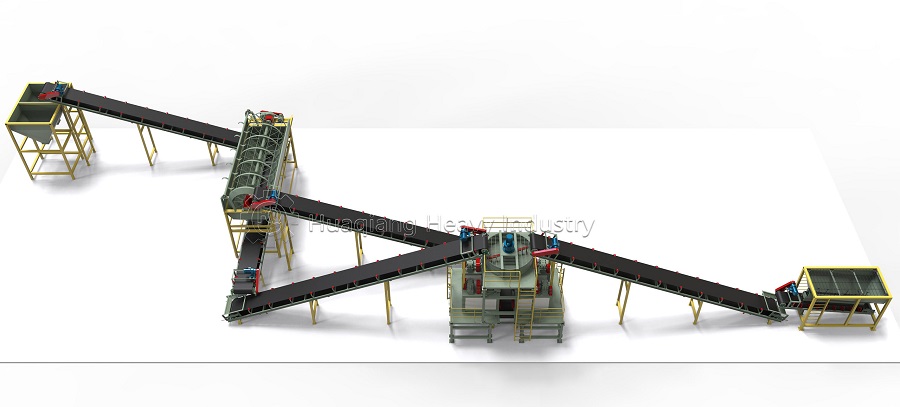
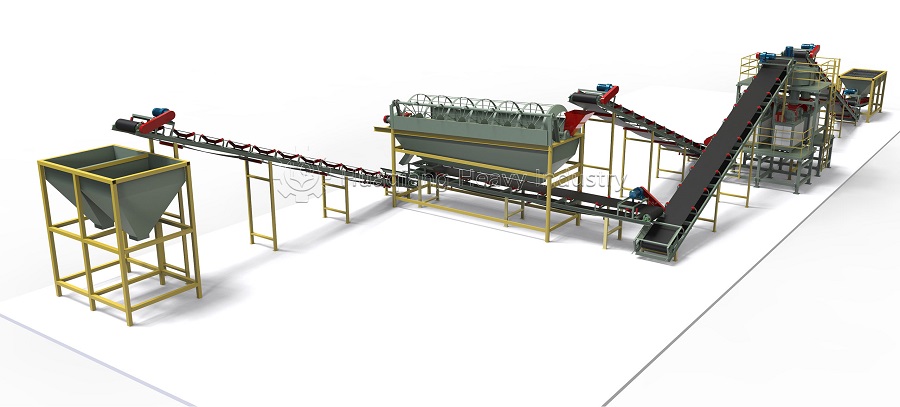
The entire production line follows a closed-loop process design of “pre-treatment – mixing – granulation – post-treatment – finished product packaging.” Each unit of equipment is precisely matched and works in synergy for high efficiency, achieving an automation level of over 90%.
Raw Material Pre-treatment and Mixing Unit
The raw material conveying system uses three belt conveyors of different specifications, respectively responsible for raw material transfer, intermediate material connection, and return material conveying. The conveyor belt width is adapted to the 8-ton/hour capacity requirement, ensuring smooth operation without material spillage, and improving conveying efficiency by 15% compared to conventional equipment.
The core mixing equipment uses two 1.2×3.0 meter twin-shaft horizontal mixers with counter-rotating blades, ensuring a mixing uniformity error of ≤3%. The equipment is equipped with a variable frequency speed control system, allowing for flexible speed adjustment based on raw material moisture content and proportions, ensuring the moisture content of the mixed materials is stably controlled within the optimal granulation range of 28%-32%.
The core granulation unit utilizes four 2.5-type double-roller extruders operating in parallel. Each machine has a capacity of 2.2 tons per hour, achieving a total designed capacity of 8 tons per hour when operating together. The rollers are made of high-chromium alloy, achieving a hardness of HRC60 or higher after quenching treatment, resulting in three times the wear resistance of ordinary materials and extending the service life to over 8000 hours.
The granulators employ a hydraulic pressure regulation system, allowing for precise control of the extrusion pressure within the range of 5-15 MPa, suitable for granulating various materials such as organic fertilizers and compound fertilizers. The roller surface features a customized serrated design, effectively enhancing material gripping force and maintaining a stable granulation rate above 92%. Particle size is uniformly controlled within 3-5mm, meeting customers’ standardized production requirements.
Post-processing and Environmental Protection Unit: The screening stage is equipped with one 1.8×6.0 meter double-layer drum screen. It employs a grading design; the upper screen separates large pieces of material, while the lower screen filters qualified particles. Unqualified material is directly returned to the mixer for regranulation via a return conveyor belt, achieving a material utilization rate of 98%.
The environmental protection system integrates a pulse-jet dust collector and exhaust gas treatment device. Through a negative pressure dust collection design, dust generated during production is collected and treated centrally, with dust emission concentration ≤10mg/m³, fully complying with local Malaysian environmental regulations. Equipment operating noise is controlled below 75dB, achieving green and low-carbon production.
Finished Product Storage and Packaging Unit:
The finished product silo has a capacity of 20 cubic meters and is equipped with a material level monitoring system to provide real-time feedback on material levels, preventing spills or shortages.
The packaging process utilizes a fully automated quantitative packaging machine. Packaging specifications can be flexibly adjusted within the range of 25-50 kg/bag, with a packaging error of ≤±0.2 kg and a packaging speed of 120 bags/hour, meeting the needs of large-scale shipments.
Core Technological Advantages of the Production Line:
Modular design is used throughout the entire process. Each equipment unit can be independently disassembled and maintained, significantly reducing downtime for maintenance and achieving an overall equipment uptime of over 95%.
An intelligent control system is adopted, integrating a PLC touchscreen operating interface. This allows for real-time monitoring of the operating parameters of each piece of equipment (speed, pressure, temperature, etc.), supports automatic fault alarms and data logging, facilitating remote management and process optimization for customers.
The overall layout of the production line is compact, requiring only 800 square meters of space, saving 20% of space compared to conventional production lines with the same capacity. Simultaneously, optimized material conveying paths shorten transfer distances, and energy consumption is reduced by 12% compared to the industry average.
The successful commissioning of this 8-ton-per-hour extrusion granulation production line once again demonstrates Huaqiang Heavy Industry’s technological strength in the field of high-end fertilizer equipment manufacturing. In the future, the company will continue to focus on equipment performance upgrades and process optimization to provide global customers with more competitive customized production line solutions.
Comparative Granulation Technologies in Fertilizer Manufacturing
This Malaysian project highlights the efficacy of extrusion-based fertilizer compaction technology. The roller press granulator production line operates on the principle of dry fertilizer granules compaction, where the fertilizer compactor applies high pressure to form dense granules. This method is a key part of modern npk fertilizer manufacturing process and organic fertilizer manufacturing process when dealing with dry powders. In contrast, the npk manufacturing process often employs alternative technologies like the rotary drum granulator, which uses a wet agglomeration method with a liquid binder. For organic systems, a dedicated organic fertilizer disc granulation production line is common, where the disc granulator for shaping forms granules through a tumbling and layering action.
The choice of fertilizer production machine technology—be it a fertilizer compaction machine for dry compaction or a drum/disc for wet agglomeration—fundamentally shapes the entire organic fertilizer manufacturing system. Extrusion offers advantages in energy efficiency (no drying needed) and granule hardness, while rotary methods often provide higher capacity and spherical shape. The optimal selection depends on raw material properties, desired product characteristics, and overall production economics.
Therefore, a comprehensive fertilizer equipment supplier must master these diverse granulation technologies to provide truly customized solutions, matching the precise mechanical, chemical, and economic requirements of each client’s operation, whether for NPK or organic fertilizer production.
We warmly welcome people from all walks of life to visit, guide, and discuss business with us, and work together to create a new future for green agricultural development!