Introduction: Addressing the Challenge of Large-Scale Organic Waste
With the intensification of global agriculture and accelerated urbanization, the generation of organic waste such as livestock manure, crop straw, and municipal sludge has increased dramatically. Traditional composting methods have limited processing capacity, high labor intensity, and long fermentation cycles, making it difficult to meet the demand for handling tens of thousands of tons or more. The large wheel compost turner emerged in response. Acting like a “giant mixer” on an organic fertilizer production line, it has become a core piece of equipment in modern large-scale organic fertilizer production due to its powerful processing capacity and efficient fermentation performance, transforming agricultural and urban organic waste into valuable soil amendments.
I. Equipment Unveiled: How Does the Giant Wheel Work?
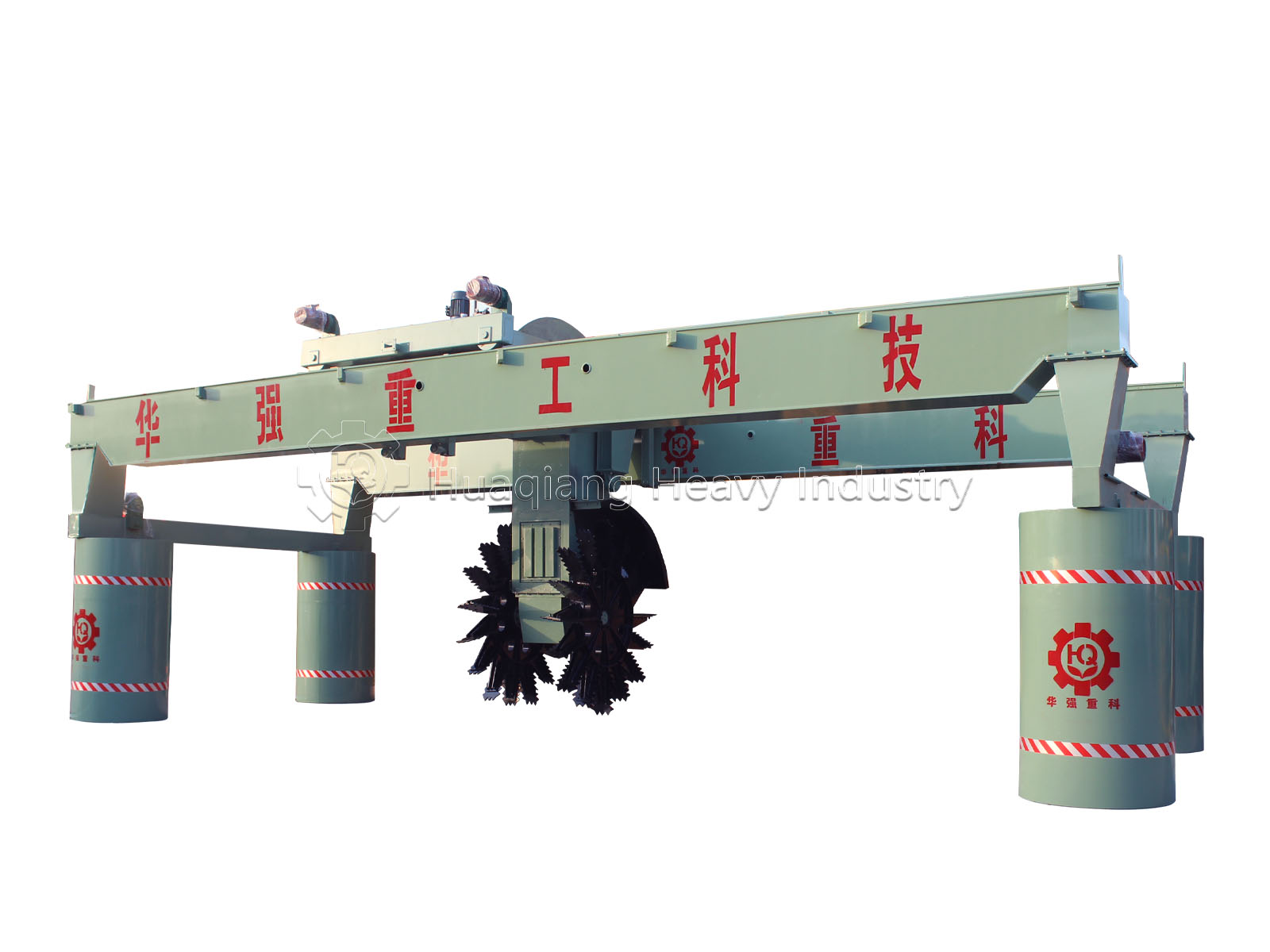
The core of a large wheel compost turner is a giant rotating wheel with a diameter of 5-10 meters. This seemingly simple design embodies ingenious engineering wisdom. Dozens of wear-resistant alloy steel turning teeth are installed on the wheel’s edge. When the wheel rotates at 10-20 rpm, these teeth act like giant “fingers,” grabbing and lifting material from the bottom of the windrow, then throwing it into the air under centrifugal force, allowing it to fully scatter and mix.
The entire machine is supported by a sturdy steel frame and moves slowly over the fermentation site (at about 0.2-1 m/min) via tracks or large-diameter tires. This movement allows the equipment to cover windrows up to a hundred meters long. The power system is typically driven by a high-power diesel engine or electric motor, ensuring sufficient force to agitate hundreds of tons of material. Advanced models are equipped with intelligent control systems that can monitor material temperature and humidity in real time and automatically adjust turning frequency and water spraying for humidification.
II. Processing Capacity: It Can “Eat” Almost Any Raw Material
Large wheel compost turners are renowned for their powerful “appetite” and processing adaptability. They can efficiently handle various bulk organic materials:
- Livestock and Poultry Manure:Processes chicken, pig, and cattle manure, killing pathogens and weed seeds through high-temperature fermentation and eliminating odors.
- Crop Straw:Shreds materials like corn stalks and wheat straw before mixing with manure to promote cellulose decomposition.
- Industrial Organic Residues:Handles distiller’s grains, sugar residue, herbal residue, etc., reducing moisture and promoting fermentation.
- Municipal Sludge:Converts sewage plant sludge into safe fertilizer, provided heavy metal content meets standards.
- Garden Waste:Recycles landscaping waste like branches and fallen leaves.
A single unit can process 500-1000 tons per day, with an annual capacity exceeding 100,000 tons, which is 3-5 times that of traditional trough-type turners.
III. Fermentation Process: The Secret to Large-Scale Efficient Composting
The composting process using a large wheel turner is a carefully controlled bioengineering operation:
- Raw Material Pretreatment:Various materials undergo solid-liquid separation, crushing, and mixing to adjust the carbon-to-nitrogen ratio to 25-30:1 and moisture to 55-60%.
- Windrow Formation:Materials are piled into large windrows 5-8 meters wide, 1.5-2 meters high, and up to a hundred meters long.
- Turning and Fermentation:The turner moves slowly along the windrow, with the wheel rotating to thoroughly turn the material.
Mesophilic Phase (1-3 days): Temperature rises to 50-60°C, initiating the first turn.
• Thermophilic Phase (4-10 days): Temperature reaches 60-70°C, turning every 2 days to kill harmful organisms.
• Cooling Phase (11-25 days): Temperature drops to 40-50°C, turning every 3-4 days to promote humus formation. - Maturity Determination:After about 20-30 days, when material temperature nears ambient, color turns dark brown, texture becomes loose, and an earthy aroma emerges, the material is considered mature.
Turning serves not only to mix but, more importantly, to provide oxygen for microorganisms, regulate temperature and humidity, and create the optimal fermentation environment.

IV. The Core of the Production Line: A Bridge Connecting Upstream and Downstream Processes
Within a complete organic fertilizer production line, the large wheel compost turner plays a crucial bridging role:
- Connecting Pretreatment and Further Processing:It ferments the mixed materials after pretreatment, then transports the matured material to subsequent processes like crushing, granulation, and packaging, forming a complete “pretreatment – fermentation – further processing” chain.
- Enabling Continuous Production:By setting up multiple windrows at different fermentation stages, the turner can work in rotation, achieving a continuous production model with constant raw material input and product output.
- Matching Full-Line Capacity:Its processing speed is adjustable, allowing precise matching with the upstream raw material supply rate and downstream granulator capacity, ensuring smooth operation of the entire production line.
- Saving Land Resources:Compared to trough fermentation, windrow fermentation can increase site utilization by over 30%, making it particularly suitable for large production bases with relatively abundant land resources.
V. Environmental and Economic Benefits: A Driver for Sustainable Development
The widespread adoption of large wheel compost turners has brought significant comprehensive benefits:
Environmental Benefits: Large-scale digestion of organic waste reduces pollution from landfill and incineration; producing organic fertilizer to replace some chemical fertilizers improves soil health and reduces agricultural non-point source pollution; the high temperatures generated during fermentation effectively kill pathogens, ensuring public health safety.
Economic Benefits: Significantly reduces labor costs for compost production; the produced organic fertilizer has stable market value; helps farms and cities solve waste disposal problems, avoiding environmental fines and creating new revenue streams.
The large wheel compost turner is not merely a simple piece of mechanical equipment but a critical technological node connecting organic waste treatment with resource recovery. It elevates traditional composting to a new industrial, large-scale level, providing an efficient and feasible solution for global circular agriculture and organic waste management. As technology advances and intelligence increases, future turners will become more energy-efficient, environmentally friendly, and intelligent, playing an increasingly important role in promoting sustainable agricultural development and building green cities.
Conclusion: Integrating Technology for a Circular Future
In conclusion, the large wheel compost turner is far more than a simple machine; it is the industrial-scale heart of modern fermentation composting technology for organic fertilizer. Its ability to process massive volumes efficiently transforms organic waste management into a systematic, value-creating operation, providing a scalable solution for sustainable agriculture and green cities.
As a central compost production machine, it is part of a larger ecosystem of equipment. It works in tandem with pre-composting processing equipment upstream and connects seamlessly to downstream processing. Within a complete production system, the fermentation composting turning technology provided by the large wheel compost fermentation machine or windrow compost turner is a critical step before material moves to granulation. The resulting compost can then be blended into formulations using a multiple silos single weigh static batching system and shaped using advanced fertilizer granulation technology. This integration of equipment—from turning to blending and granulation—comprises the essential equipments required for biofertilizer production, creating a closed-loop from waste to valuable soil amendment.
Ultimately, by enabling large-scale, efficient organic recycling, this technology is a cornerstone for building resilient, circular agricultural systems that benefit both the economy and the environment.