Opening new pathways in organic fertilizer production and environmental treatment

In the fields of organic fertilizer production, bioenergy development, and environmental treatment, a highly efficient piece of equipment is becoming the industry’s “new favorite”: the simple compost turning machine. This equipment is specifically designed for organic materials such as livestock and poultry manure, crop straw, and kitchen waste. Through aerobic fermentation technology, it easily achieves the resource utilization of organic waste.

Traditional organic material processing often faces problems such as low fermentation efficiency and high labor costs. The simple compost turning machine overcomes these challenges with its unique advantages. It features an automated operation design and is equipped with a PLC control system, allowing for precise control of movement, turning, and oxygen supply, reducing manual intervention. During operation, the equipment moves along the fermentation tank, turning the materials through a stacking mechanism. The oxygen supply system ensures sufficient oxygen, accelerating microbial activity and significantly improving fermentation efficiency, allowing organic materials to be quickly converted into high-quality organic fertilizer.
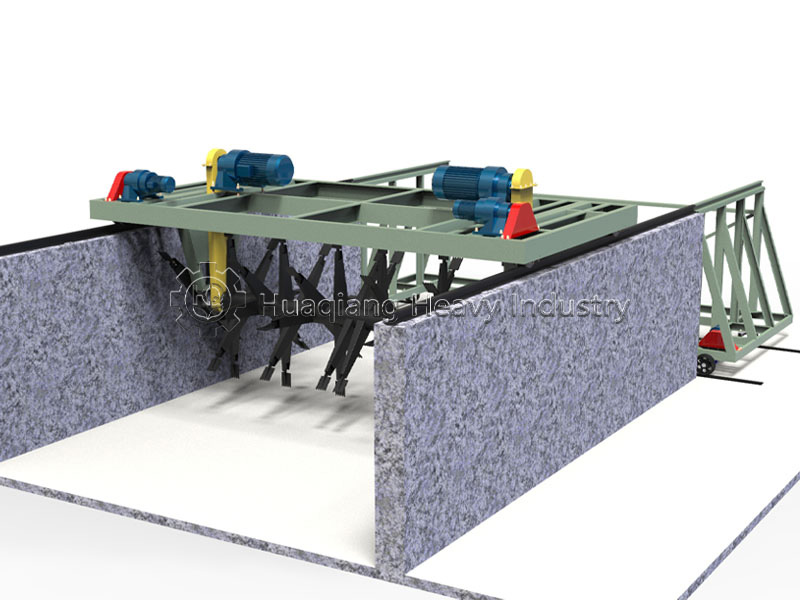
Furthermore, this equipment is highly adaptable and can meet the processing needs of different organic materials. Whether it’s batch processing on an organic fertilizer production line or waste conversion in environmental treatment projects, it can handle the task. As a professional manufacturer, we also provide complete organic fertilizer production line solutions, including NPK fertilizer production linesdisc granulation production lines, and other equipment, covering everything from material processing to finished product processing.

Today, environmental protection and resource recycling are becoming trends. The simple compost turning machine not only helps the agricultural sector produce green organic fertilizers but also promotes the reduction and resource utilization of organic waste, contributing to environmental protection.
What raw materials can be used in a disc granulation production line?

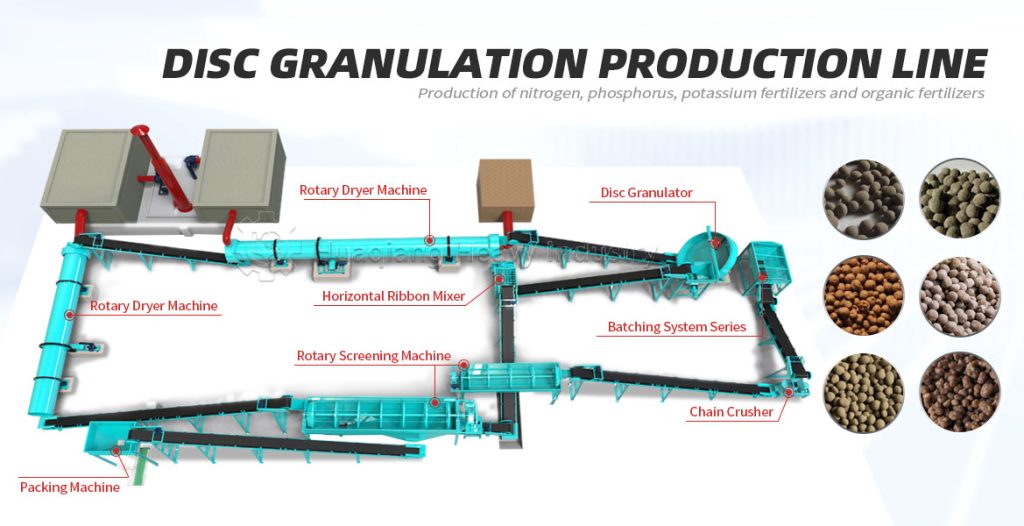
Disc granulation production lines, with their advantages of uniform granulation, high molding rate, and simple operation, are widely used in the production of organic fertilizers and compound fertilizers. The core requirement for raw materials is suitable viscosity and moisture content.

Organic fertilizer raw materials are the core suitable category, mainly consisting of fermented and decomposed organic materials. Common examples include fermented animal manure (chicken manure, pig manure, cow manure, etc.), which, after decomposition, has a loose texture and natural viscosity, allowing for molding without excessive binders; fermented agricultural waste is also suitable, such as crushed and fermented corn stalks, wheat stalks, and rice husks, which need to be mixed with manure-based materials to increase viscosity; in addition, industrial organic waste such as distiller’s grains, vinegar residue, and pharmaceutical residue, after pretreatment to adjust moisture content, can also be adapted to the disc granulation process.

Compound fertilizer raw materials mainly consist of inorganic fertilizers, and are compatible with various basic fertilizers and trace element fertilizers. Basic fertilizers include urea, monoammonium phosphate, diammonium phosphate, potassium chloride, potassium sulfate, etc. These raw materials need to be mixed and their moisture content adjusted to a suitable range, utilizing the centrifugal force and friction of the rotating disc granulator to achieve granulation; trace element fertilizers such as magnesium sulfate, zinc sulfate, and borax can be mixed into the basic fertilizers as auxiliary nutrient raw materials to complete granulation and improve the overall nutrient content of the fertilizer.

Auxiliary raw materials are used to optimize the granulation effect. Common examples include binders (such as bentonite and humic acid), which are added to raw materials with insufficient viscosity to improve particle strength; fillers (such as fly ash and zeolite powder) can adjust the moisture content and specific gravity of the raw materials, preventing particles from becoming too large or too small. When selecting raw materials, it is necessary to reasonably proportion the moisture content and composition of the raw materials according to the type of finished fertilizer and the requirements of the disc granulation process to ensure granulation efficiency and product quality.

Analysis of key factors for efficient operation of disc granulation production lines

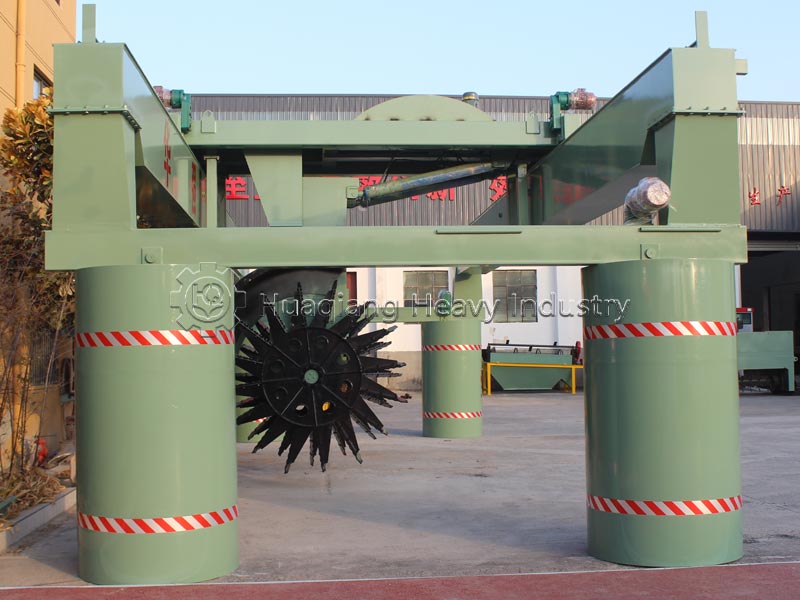
The efficient and stable operation of a disc granulation production line hinges on the precise coordination of equipment at each stage. The large-diameter large wheel compost turning machine, double axis paddle mixer, and disc granulator form the core linkage chain, directly determining the quality of raw material composting, mixing uniformity, and granule formation. These are crucial for increasing production capacity and product quality.

The large wheel compost turning machine lays the foundation for high-quality raw materials in the production line. During the raw material pretreatment stage, its efficient turning and mixing allow the raw materials to fully contact the air, rapidly increasing the fermentation temperature and inhibiting harmful bacteria, ensuring uniform composting and stable nutrient content. Insufficient turning can lead to incomplete composting, resulting in problems such as loose granules and uneven nutrient distribution.

The double axis paddle mixer builds upon the pretreatment results, achieving precise material conditioning. After the composted raw materials, auxiliary materials, and microbial agents are added in proportion, its dual-shaft structure allows for rapid and thorough mixing of materials. It can also adjust moisture content and particle size according to granulation requirements, forming high-quality material suitable for the disc granulator. Compared to ordinary mixers, it offers higher mixing efficiency and better uniformity, significantly improving the subsequent granulation and molding rate.

The synergistic operation of these three components ultimately ensures the efficient operation of the production line, reduces material waste, and improves granule uniformity and strength. Therefore, controlling the operating quality of the large wheel compost turning machine and the double axis paddle mixer is essential for maximizing the efficiency of the disc granulation production line.

Scientifically designing a disc granulation production line: Key steps and core considerations

Disc granulation production lines have become the mainstream choice for organic and compound fertilizer production due to their high granulation rate, convenient operation, and adaptability to various fertilizer types. Building an efficient and stable production line requires careful consideration of initial planning, equipment matching, and process integration.

Initial planning requires precise needs assessment. First, clearly define the production capacity target and determine the model and specifications of the disc granulator based on your production scale, avoiding overcapacity or undercapacity. Second, analyze the characteristics ofthe raw materials, predicting the granulation difficulty based on parameters such as moisture content, particle size, and viscosity, providing a basis for subsequent equipment debugging and process setting. Simultaneously, plan the site layout rationally, reserving space for equipment installation, material transportation, and future maintenance to ensure a smooth production process.

Matching core equipment is crucial. In addition to the core disc granulator, suitable pre-processing equipment (crushers, mixers) and post-processing equipment (dryers, screening machines) are necessary: raw materials are crushed to a uniform particle size, then mixed and conditioned using a fertilizer mixer machine to improve granulation efficiency; the granulated wet particles need to be dried to remove excess moisture, and then screened to select particles of the correct size. It is essential that the capacity of all equipment is matched to avoid any single stage becoming a production bottleneck.

Post-installation debugging and standardized operation are indispensable. After the production line is built, small-scale trial production is necessary to adjust parameters such as disc rotation speed, inclination angle, and material moisture content until the granulation rate and uniformity meet the standards; simultaneously, establishing standardized operating procedures and regularly maintaining the equipment will ensure the long-term stable operation of the production line.