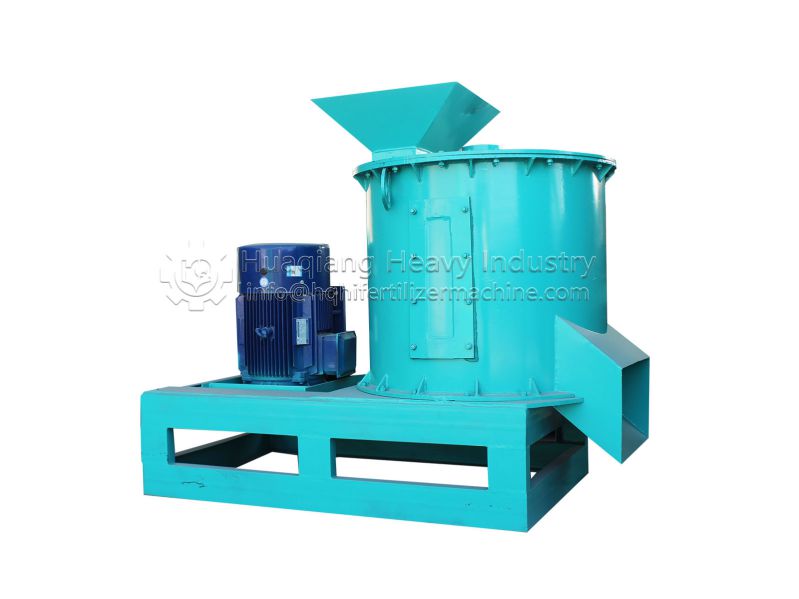
High-efficiency crushing equipment boosts fertilizer production and solves material processing challenges

In fertilizer production, material crushing is one of the key steps. Whether it’s bio-organic fertilizer or NPK compound fertilizer, raw materials need to be crushed to a uniform particle size to ensure the smooth operation of subsequent granulation and mixing processes.

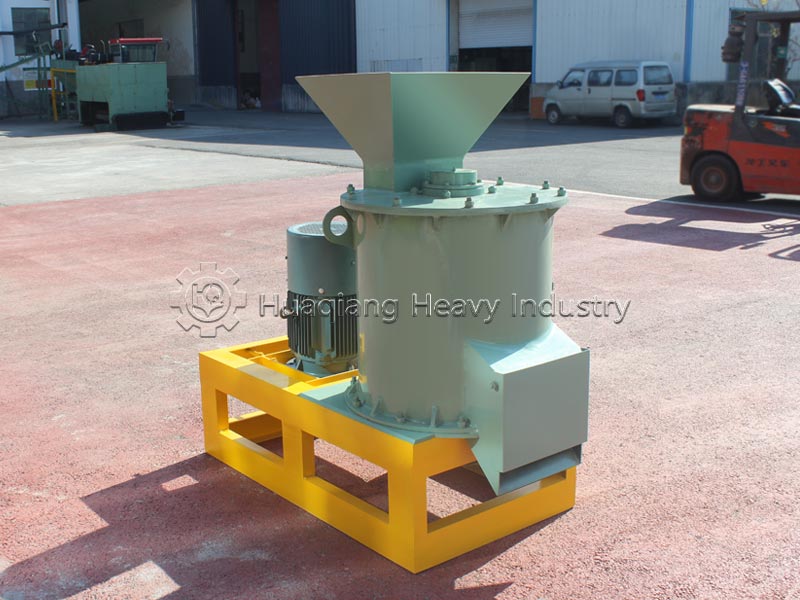
When it comes to high-efficiency crushing equipment, cage crushers are undoubtedly a popular choice. As a typical fertilizer crusher, its unique cage-type rotor design easily handles high-hardness and high-moisture materials—such as organic waste with high water content. Its high-speed rotating cage bars, combined with wear-resistant crushing teeth, can quickly crush materials, and by adjusting the gap between the rotor and the fixed crushing plate, it can precisely control the output particle size, ensuring uniform particle size after crushing and meeting the needs of different fertilizer production lines.

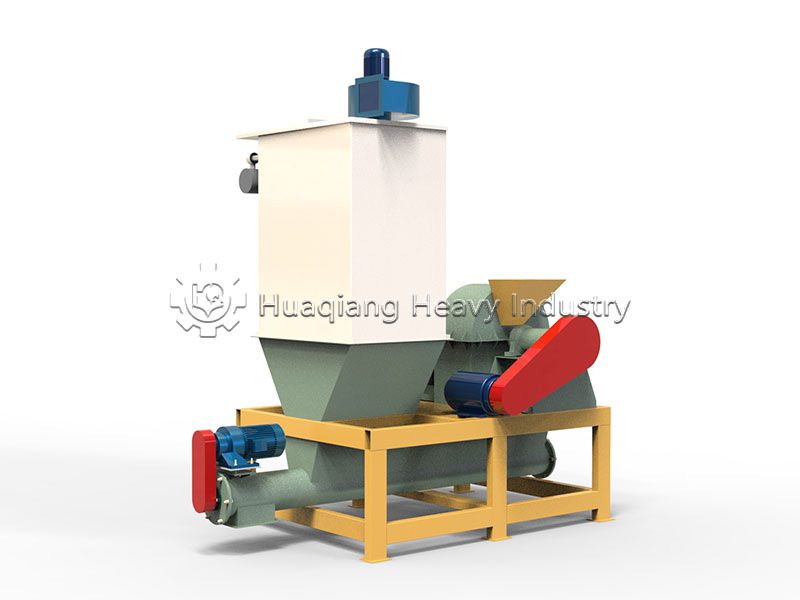
In addition to cage crushers, other crushing equipment is also used in fertilizer production depending on the characteristics of the raw materials. When processing biomass raw materials such as straw and rice straw, straw crushers can crush the raw materials into fine fibers, facilitating microbial decomposition and fermentation; for half-wet organic materials, half-wet material crushers can prevent material sticking and clogging, maintaining stable crushing efficiency; while chain crushers and horizontal crushers are suitable for medium-hardness fertilizer raw materials, flexibly adapting to different production scenarios.

Today, with the large-scale development of bio-organic fertilizer production line and NPK fertilizer production line, the adaptability of crushing equipment is constantly improving. The right crushing equipment can become a powerful “assistant” in fertilizer production, helping companies improve product quality and expand production scale.

The “Pre-treatment Powerhouse” of bio-organic fertilizer production lines

In the bio-organic fertilizer production process, the efficiency of the pre-treatment stage directly determines the quality of subsequent production, and the half-wet material crusher is the core equipment in this stage. As one of the key pieces of bio-organic fertilizer equipment, it perfectly solves the problem of processing high-humidity materials, ensuring the stable operation of the bio-organic fertilizer production line.

Traditional dry crushers often encounter problems such as clogging and low efficiency when processing wet materials such as wet straw and composted organic fertilizer due to material adhesion. However, the half-wet material crusher, with its special design, can easily handle wet materials with a moisture content of 30%-60%. Its built-in anti-clogging device prevents material adhesion, and the high-speed rotating crushing elements quickly crush the wet material into uniform particles through impact, cutting, and grinding. This not only reduces equipment failures but also improves the efficiency of subsequent fermentation and granulation processes.

In a complete bio-organic fertilizer production line, the half-wet material crusher usually connects the raw material pre-treatment and fermentation stages. For example, when processing agricultural waste, it first crushes wet straw, livestock manure, and other raw materials to a suitable particle size, increasing the contact area of the materials and allowing for more thorough microbial fermentation; when used in conjunction with other bio-organic fertilizer equipment such as chain crushers and horizontal crushers, it can flexibly adapt to different raw materials and meet diverse production needs.

In addition, this equipment also has the advantages of convenient maintenance and controllable particle size. For organic fertilizer production enterprises, choosing a high-quality half-wet material crusher can effectively improve the overall production capacity of the production line and contribute to the development of green agricultural circular economy.

Key equipment for high-efficiency pretreatment in bio-organic fertilizer production lines

In the field of organic waste resource utilization, sticky and moist livestock and poultry manure, pasty kitchen waste, and insufficiently dried agricultural straw often pose pretreatment challenges due to their high moisture content and tendency to stick together. As an important member of the bio-organic fertilizer equipment system, the widespread application of half-wet material crushers has successfully transformed this technical bottleneck into a starting point for high-efficiency production.

The core capability of the half-wet material crusher lies in its excellent “moisture resistance” and “anti-clogging” design. It can efficiently process viscous materials with a moisture content of 30%-50%. This pretreatment not only solves the problems of subsequent conveying and mixing but also creates an ideal material state for deep fermentation.

In a complete bio-organic fertilizer production line, this equipment plays a crucial “pioneer” role. Its refined processing of raw materials directly improves fermentation efficiency and homogenization. The thoroughly crushed material has a significantly increased specific surface area, which is beneficial for the uniform inoculation and rapid reproduction of functional microorganisms.

The raw materials processed by this equipment exhibit significant advantages when entering the new type organic fertilizer granulator. The uniform and fine material properties significantly improve the granulation rate and enhance particle compactness and uniformity during the granulation process.

From a broader perspective, the technological advancements in half-wet material crushers have greatly broadened the range of raw material choices for bio-organic fertilizer production lines. This not only improves resource utilization but also provides a reliable guarantee for the production of high-quality bio-organic fertilizer products.

Key equipment for handling high-moisture raw materials in organic fertilizer production lines

In modern organic fertilizer production lines, the half-wet material crusher, as a crucial piece of equipment, demonstrates unique raw material processing capabilities. Unlike traditional fertilizer crushers, it is specifically designed for high-moisture organic materials, effectively solving the crushing problem of raw materials after fermentation.

In the complete organic fertilizer production line process, the half-wet material crusher occupies a critical position after the fermentation process and before the granulation process. It can directly process organic materials with a moisture content of 25%-50%, including livestock and poultry manure, filter mud, and straw. This characteristic not only simplifies the process flow but also significantly reduces the energy consumption cost of the entire organic fertilizer production line.

In practical applications, the half-wet material crusher forms a good synergistic effect with other organic fertilizer production equipment. The materials processed by it meet the requirements of subsequent processes in terms of particle size uniformity and moisture content, creating favorable conditions for the stable operation of the organic fertilizer granulator. Uniform raw material particle size not only improves granulation quality but also ensures the consistency of nutrients in the final product.

It is worth mentioning that this crushing equipment exhibits broad raw material adaptability in organic fertilizer production lines. Whether it’s highly viscous livestock and poultry manure or straw-like materials with high fiber content, ideal pulverization results can be achieved by adjusting the equipment parameters. This flexibility makes it an indispensable key piece of equipment in modern organic fertilizer production lines.
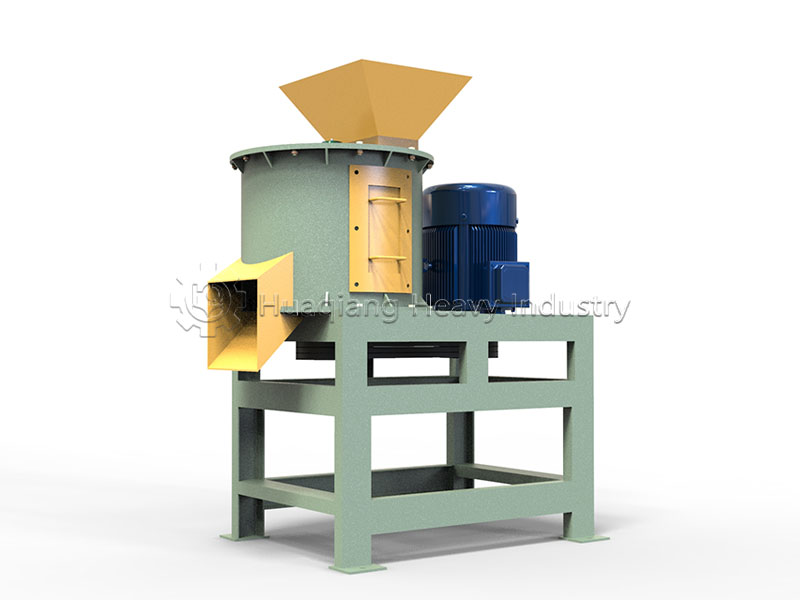
Analysis of the working principle of half-wet material crusher in organic fertilizer equipment

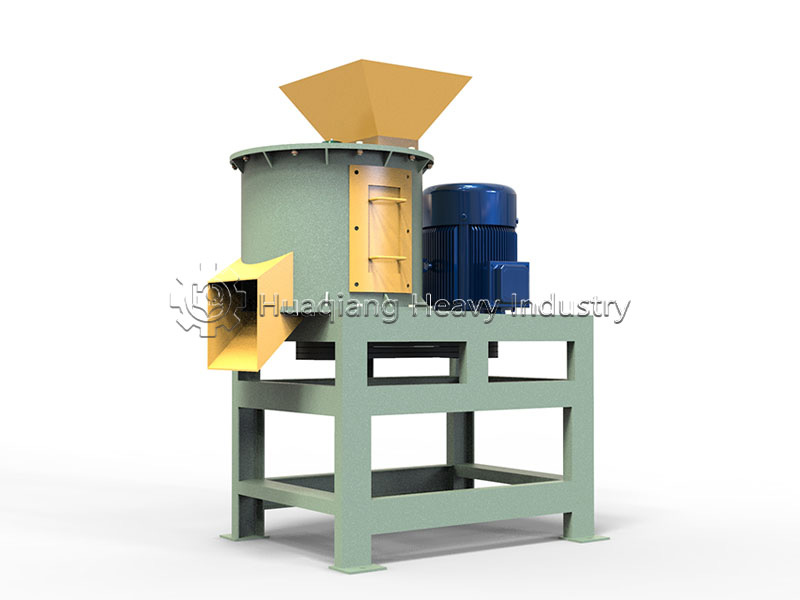
In organic fertilizer production lines, crushing is a crucial step. The half-wet material crusher is specifically designed to handle fermented materials with high moisture and fiber content. Its unique design concept combines three primary forces—shearing, tearing, and impact—to achieve efficient crushing.

1.Feeding and Preliminary Crushing
Pre-fermented organic materials (such as livestock manure, straw, sludge, etc.) are fed into the crushing chamber through the inlet. These materials typically have a moisture content of 25%–50%, making them sticky and prone to tangling.
2.High-Speed Rotor Rotation
At the core of the equipment is a heavy-duty rotor that rotates at high speed. Multiple sets of wear-resistant hammer blades or knives are mounted alternately on the rotor. Driven by an electric motor, the rotor generates strong torque and linear speed.
3.Shearing and Tearing
The rotating hammer blades and the wear-resistant tooth plate or liner fixed on the machine body form a narrow gap. As the material enters this gap, it is quickly cut and torn apart by the powerful shearing and tearing forces generated by the high-speed relative motion.

4.High-Speed Impact
Simultaneously, the initially crushed material particles are struck at high speed by the hammer blades inside the chamber, further breaking them down into finer particles.
5.Forced Discharge
The crushed fine particles are forced through the screen mesh at the bottom under the airflow generated by the rotor’s rotation and their own gravity, completing the crushing process. The screen mesh aperture can be replaced to meet the required fineness of the final product.

The half-wet material crusher is an indispensable key equipment in organic fertilizer production. Its unique working principle enables it to effectively process sticky, wet, and tangled organic materials without clogging.