A powerful and efficient granulator for multiple applications: The ideal choice for organic fertilizer production

In the field of pellet processing, disc granulators have become popular equipment due to their superior performance, especially in organic fertilizer production. They are a core component of organic fertilizer disc granulation production lines, providing efficient solutions for pellet processing across multiple industries.

This organic fertilizer disc granulator boasts significant advantages, achieving a pelleting rate exceeding 95%. Its main gear undergoes high-frequency quenching treatment, effectively doubling its service life and significantly reducing maintenance costs. Its core component is an adjustable tilting disc with an adjustable tilt angle (30°-60°) and rotation speed (5-30 rpm). The disc’s inner wall is lined with wear-resistant material, allowing it to adapt to materials with different properties—from livestock manure and fermented straw in organic fertilizer production to iron ore powder in the metallurgical industry and cement raw materials in the building materials industry—all can be efficiently converted into pellets.
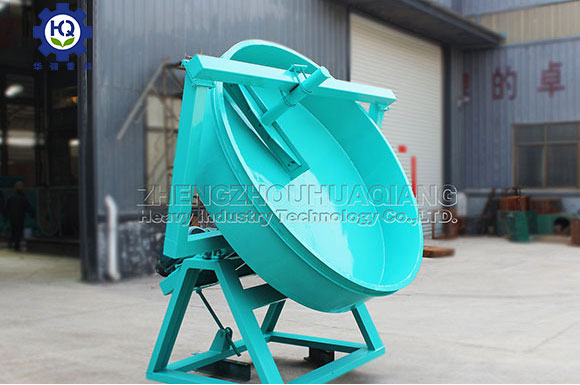
In the organic fertilizer production process, its operating logic is clear and efficient. First, the organic raw materials are pulverized to 0.1-1mm using a fertilizer crusher. After thorough mixing in a fertilizer mixer machine, they are evenly fed into a disc by a feeding device. Simultaneously, a water spraying device precisely controls the moisture content, maintaining the material’s moisture content at 10%-20%. As the disc rotates, the material is rolled into spheres under centrifugal force and friction. Particles with a sphericity exceeding 80% are screened by a fertilizer screener machine. Qualified products proceed to the subsequent drying stage, while unqualified particles are returned for reprocessing, ensuring stable finished product quality.

Besides organic fertilizer, it is also widely used in the metallurgical, building materials, and chemical industries: in metallurgy, it is used for granulation of mineral powder to facilitate subsequent sintering and smelting; in building materials, it is used to produce cement raw material granules to improve cement quality; and in chemicals, it is used for granulation of catalysts and pigments to enhance product flowability.
What is the working principle of an organic fertilizer disc granulation production line?

In the field of organic fertilizer production, the organic fertilizer disc granulation production line has become the preferred equipment for small and medium-sized enterprises due to its short process and low investment. So, how does this equipment transform loose organic raw materials into uniform granules?

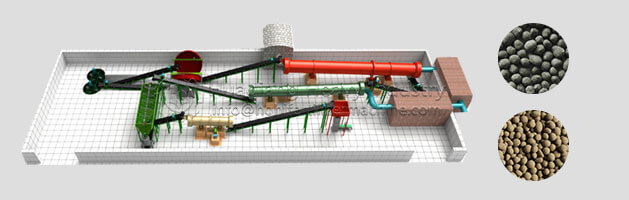
The entire production line’s workflow revolves around the organic fertilizer disc granulator, the core equipment, and works in conjunction with a multi-bin single-scale static automatic batching system, belt conveyors, coating machines, and other equipment. First, after the raw material pretreatment stage, the multi-bin single-scale static automatic batching system precisely proportions the nitrogen, phosphorus, potassium, and organic raw materials according to production needs, ensuring that the nutrient content meets the 20%-48% standard. This step lays the foundation for granule quality.

Next, the proportioned raw materials are uniformly transported to the disc granulator via a belt conveyor. The disc granulator adopts a large-angle tilt design (usually 30°-50°). When the motor drives the disc to rotate, the raw materials inside the disc are subjected to the combined action of centrifugal force, friction, and gravity, constantly tumbling and colliding. At the same time, according to the moisture requirements of the raw materials, the equipment precisely sprays an appropriate amount of binder, allowing the raw materials to gradually agglomerate into small particles. As the disc continues to rotate, the small particles continuously adsorb surrounding raw materials, gradually growing into uniform granules of 2-5mm – this is the key to the disc granulation process.

After the granules are formed, unqualified fine powder is separated through a screening device at the bottom of the disc and returned to the granulation process. Qualified granules are then transported to the coating machine for surface treatment to improve granule stability and moisture resistance. Finally, they are transported via belt conveyor to subsequent stages, completing cooling, packaging, and other processes, ultimately becoming finished organic fertilizer products ready for shipment.

Facilitating efficient organic fertilizer production and promoting green agricultural development

In the field of organic fertilizer production, a highly efficient and reliable granulation equipment is crucial, and the organic fertilizer disc granulator is a highly favored choice. As the core organic fertilizer granulation equipment, it can accurately convert fermented organic raw materials such as livestock and poultry manure and straw into granular organic fertilizer, injecting strong momentum into green agricultural development.

The organic fertilizer disc granulator offers significant advantages. Its granulation rate exceeds 95%, far surpassing ordinary granulation equipment. The main gear is treated with high-frequency quenching, doubling its service life and reducing equipment replacement costs. The equipment adopts an inclined disc design, coupled with adjustable rotation speed and inclination angle, allowing it to adapt to different types of organic raw materials. Whether the material is powdery or slightly viscous, it can be efficiently granulated, fully demonstrating its strong material adaptability.

From a workflow perspective, it is simple and scientific to operate. First, the organic raw materials are pre-processed, crushed to a particle size of 0.1-1mm and thoroughly mixed, and then evenly fed into the disc by the feeding device. At the same time, the water spraying device precisely sprays an appropriate amount of water to maintain the material’s moisture content at 10%-20%. As the disc rotates, the materials tumble and bond under the action of centrifugal force, friction, and gravity, gradually forming granules with a sphericity exceeding 80%. Finally, after screening, unqualified granules are returned for reprocessing, ensuring the quality of the finished product.

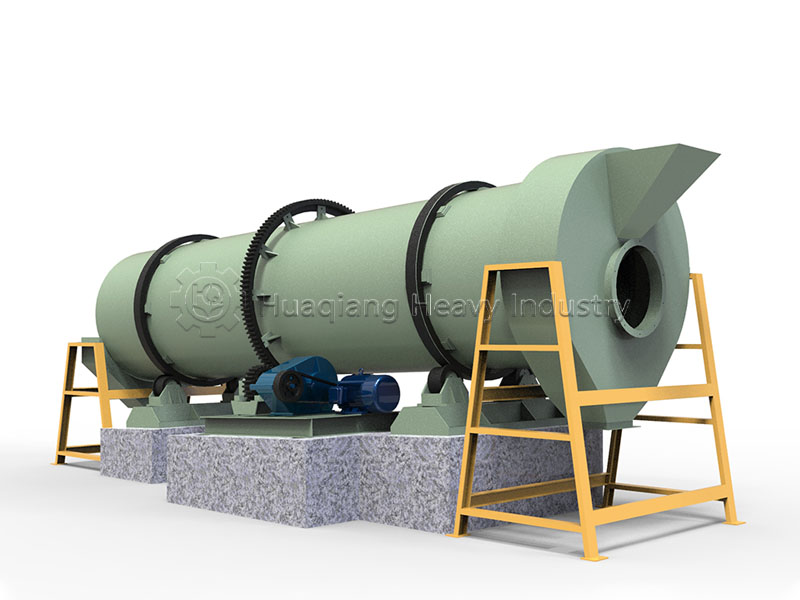
This equipment is not only suitable for small and medium-sized organic fertilizer production plants but can also be integrated into large-scale organic fertilizer disc granulation production lines, working in conjunction with supporting equipment such as fertilizer crushers, mixers, and dryers to build a complete organic fertilizer production equipment system. The resulting granular organic fertilizer has uniform nutrients, high strength, is easy to store and transport, and can also improve soil structure and enhance soil fertility.