In the field of pellet processing, disc granulators have become popular equipment due to their superior performance, especially in organic fertilizer production. They are a core component of organic fertilizer disc granulation production lines, providing efficient solutions for pellet processing across multiple industries.
This organic fertilizer disc granulator boasts significant advantages, achieving a pelleting rate exceeding 95%. Its main gear undergoes high-frequency quenching treatment, effectively doubling its service life and significantly reducing maintenance costs. Its core component is an adjustable tilting disc with an adjustable tilt angle (30°-60°) and rotation speed (5-30 rpm). The disc’s inner wall is lined with wear-resistant material, allowing it to adapt to materials with different properties—from livestock manure and fermented straw in organic fertilizer production to iron ore powder in the metallurgical industry and cement raw materials in the building materials industry—all can be efficiently converted into pellets.
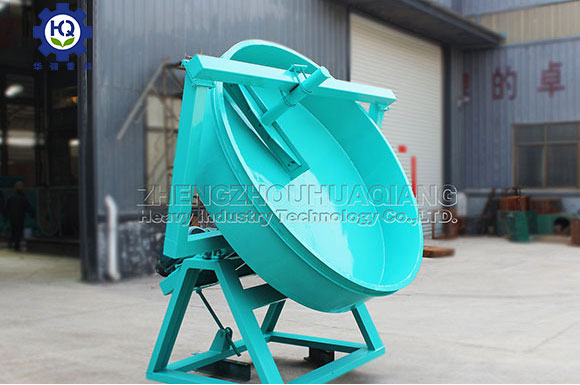
In the organic fertilizer production process, its operating logic is clear and efficient. First, the organic raw materials are pulverized to 0.1-1mm using a fertilizer crusher. After thorough mixing in a fertilizer mixer machine, they are evenly fed into a disc by a feeding device. Simultaneously, a water spraying device precisely controls the moisture content, maintaining the material’s moisture content at 10%-20%. As the disc rotates, the material is rolled into spheres under centrifugal force and friction. Particles with a sphericity exceeding 80% are screened by a fertilizer screener machine. Qualified products proceed to the subsequent drying stage, while unqualified particles are returned for reprocessing, ensuring stable finished product quality.
Besides organic fertilizer, it is also widely used in the metallurgical, building materials, and chemical industries: in metallurgy, it is used for granulation of mineral powder to facilitate subsequent sintering and smelting; in building materials, it is used to produce cement raw material granules to improve cement quality; and in chemicals, it is used for granulation of catalysts and pigments to enhance product flowability.