Introduction: When Composting Meets Complex Terrain
On vast farms, muddy livestock facilities, or organic waste treatment sites on urban fringes, composting work often faces challenges such as complex terrain, soft ground, and irregular spaces. Traditional wheeled turners might get stuck in the mud or have limited mobility here. The windrow compost turner, with its unique tracked travel system, acts like an “armored vehicle” among agricultural machinery, easily handling these difficult working conditions. It has become an indispensable core piece of equipment in modern large-scale organic fertilizer production, efficiently transforming various organic wastes into fertile “black gold.”
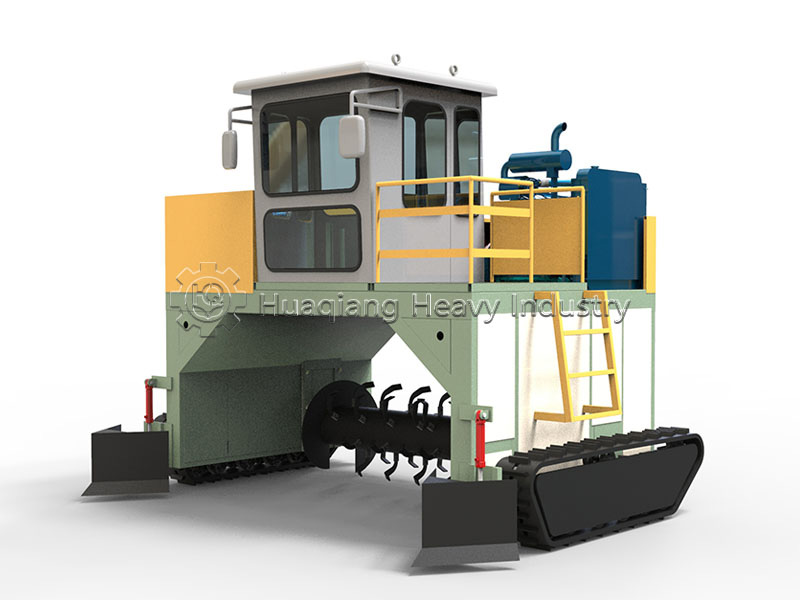
I. The Core of the Equipment: Why is the Crawler Design a Breakthrough?
The most distinctive feature of a windrow compost turner is its tracked undercarriage. This design draws from the principles of tanks and construction machinery, significantly reducing ground pressure (typically only 0.05-0.1 MPa) by increasing the contact area. This allows it to move freely on sites with high moisture content, soft ground, or even on slopes (≤15°), without easily sinking or slipping like wheeled equipment.
The core working component of the machine is a turning drum or a set of sturdy turning teeth controlled by a hydraulic arm. The hydraulic system provides exceptional flexibility: the turning arm can be raised, lowered, and rotated, easily adapting to piles of different heights from 0.5 to 2.5 meters. The turning teeth penetrate the bottom of the pile, lifting, breaking up, and throwing the bottom layer of material—which may be in an anaerobic state—to the surface, achieving thorough mixing and oxygenation of the material.
II. Powerful Raw Material Processing Capability: It Can Turn Almost Anything
With its powerful drive and adaptability, the windrow compost turner can handle various organic raw materials with different characteristics:
- High-Moisture, Viscous Materials:Such as fresh livestock manure, municipal sludge, and distiller’s grains. Its powerful shearing and throwing force can effectively break up material clumps, promoting water evaporation and uniform mixing.
- Coarse Fibrous Materials:Such as corn stalks and garden trimmings. The equipment can be equipped with reinforced blades or a crushing function to shred materials while turning, accelerating decomposition.
- Complex Mixed Materials:In organic fertilizer production, it’s common to mix and ferment multiple raw materials like manure, straw, and fungal residue. The crawler turner’s high processing capacity and excellent mixing uniformity (turning rate >95%) make it an ideal choice.
A single unit can process 50-150 tons of material per hour, with an efficiency 1.5-2 times that of traditional trough-type turners, making it particularly suitable for large production lines with a daily output exceeding one hundred tons.
III. Fermentation Process: The Guardian of Efficient Aerobic Composting
The composting process using a crawler turner is a dynamically controlled aerobic fermentation process:
- Pile Formation:Pretreated materials are piled into long, trapezoidal windrows with a base width of 3-5 meters and a height of 1-1.8 meters. Passages are left between windrows for the turner to travel.
- Turning Operation:The turner moves slowly along the windrow (speed 0.3-2 m/min). The turning teeth act like a giant “hand,” grabbing, lifting, and throwing material from the bottom, creating a continuous “waterfall” effect. This achieves three key objectives: replenishing oxygen, releasing moisture vapor, and homogenizing temperature.
Mesophilic Phase: Turning promotes mesophilic bacterial activity, rapidly raising the temperature to 50-60°C.
• Thermophilic Phase: Regular turning maintains high temperatures of 60-70°C, killing pathogens while preventing overheating in the core.
• Cooling and Maturation Phase: Turning helps cool the material and allows mesophilic bacteria to become active again, synthesizing stable humus. - Maturity Determination:After a cycle of 15-25 days, when the material becomes loose, dark brown, odorless, and its temperature matches the ambient, it is considered mature.
IV. Production Line Integration: The Flexible and Efficient Fermentation Core
Within an organic fertilizer production line, the windrow compost turner demonstrates exceptional integration flexibility and efficiency:
- Strong Site Adaptability:It operates directly on open ground, whether paved or unpaved, without the need for expensive fermentation tanks, significantly reducing capital investment in infrastructure.
- Supports Multi-Zone Rotation:Multiple fermentation zones can be designated within the same site for different stages like feeding, high-temperature fermentation, and maturation. The turner flexibly moves between zones, enabling continuous production.
- Matches Production Rhythm:Its travel and turning speeds can be infinitely adjusted, allowing precise control of the fermentation cycle based on the upstream feeding rate and downstream granulator capacity, ensuring smooth operation of the entire production line.
- Enables Mobile Operations:For dispersed farms or temporary treatment sites, the crawler turner can be transported to different locations for operation, providing flexible waste treatment services.
V. Maintenance: Ensuring Continuous and Efficient Operation
To ensure this “big machine” works persistently and stably, scientific maintenance is crucial:
- Daily Inspection:Check track tension, bolt tightness, and for hydraulic line leaks.
- Regular Maintenance:Replace hydraulic oil and filters according to schedule, lubricate all moving joints, and inspect and replace worn turning teeth.
- Post-Operation Cleaning:Promptly remove fibrous debris wrapped around shafts and teeth to prevent corrosion and imbalance.
- Seasonal Storage:When not in use for long periods, clean the equipment thoroughly, apply rust prevention to exposed metal parts, and store it on dry, level ground.
Integrated Composting Systems for Modern Biofertilizer Manufacturing
The windrow compost turner is a pivotal technology within modern fermentation composting technology for organic fertilizer. Its tracked design is part of a broader spectrum of fermentation composting turning technology that includes other specialized equipment such as the trough-type compost turner for controlled environments, the large wheel compost turner for large-scale windrows, and the chain compost turner for tough materials. These machines are central to optimizing the organic fertilizer fermentation process, often implemented within a trough-type aerobic fermentation composting technology framework for maximum efficiency.
These essential pre-composting processing equipment form the core equipments required for biofertilizer production. After complete stabilization through scientifically managed turning, the matured organic matter proceeds to the final shaping stage. This is typically achieved using a disc granulation production line, which transforms the compost into uniform, market-ready fertilizer granules. The integration of advanced turning technologies—from windrow and trough systems to hydraulic variants—with downstream processing creates a seamless and efficient workflow. This sophisticated integration of biological management and mechanical engineering enables the large-scale, efficient conversion of diverse organic waste streams into high-value biofertilizers, closing nutrient loops and providing essential support for sustainable soil management and global ecological agriculture.
Conclusion
The windrow compost turner not only overcomes terrain limitations but also represents an efficient, flexible, and highly adaptable solution for large-scale composting. It transforms chaotic organic waste into an orderly cycle of humus, serving as a key technological piece of equipment connecting modern scaled agriculture, environmental protection, and sustainable soil management. With the application of intelligent control technology and new energy power, future windrow compost turners will become greener and smarter, continuing to play an indispensable role in global organic waste resource recovery and the development of ecological agriculture.