In bio-organic fertilizer production lines, fertilizer granules compaction technology is not merely a single granulation step, but a core optimization process that runs through the entire process from raw material processing to finished product. Its precise integration with various bio-organic fertilizer equipment directly determines the efficiency, quality, and environmental performance of the production line, making it a critical technological support for bio-organic fertilizer production.
Adaptation in the pretreatment stage is fundamental to the successful implementation of the process. Fermented organic fertilizer raw materials need to be processed by crushing and screening equipment. The requirements of the fertilizer granules compaction technology regarding raw material particle size and moisture content drive the precise control of the pretreatment equipment—ensuring that the raw materials are refined to a particle size suitable for extrusion, and the moisture content is controlled within the optimal range of 30%-40%, avoiding problems such as roller sticking and uneven molding.
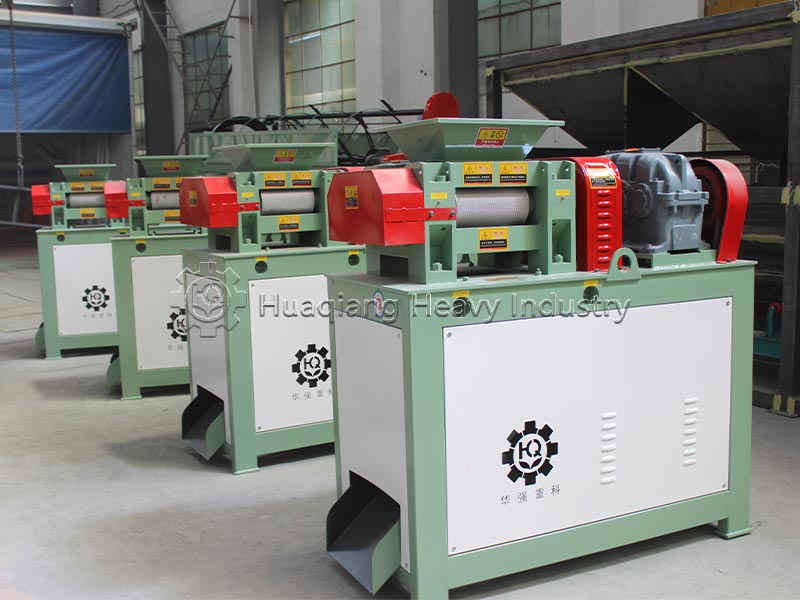
In the core granulation stage, this technology works efficiently with the fertilizer compaction machine. The fertilizer compaction machine receives the pre-treated raw materials and completes the molding process by setting parameters such as extrusion pressure and roller speed. Compared with other processes, it does not require the addition of extra binders, ensuring particle hardness and molding rate while maximizing the retention of nutrients in the raw materials. The resulting granules are also better suited for subsequent cooling and screening equipment.
In subsequent stages, the advantages of the process become even more apparent. The extruded granules have high uniformity, which improves the heat exchange efficiency of the cooling equipment, reduces the sorting load of the screening equipment, and ensures the smooth operation of the production line.