DAP (diammonium phosphate) and MAP (monoammonium phosphate) compound fertilizers, due to their high phosphorus content, have stringent granulation requirements. Using an NPK fertilizer production line for granulation requires careful adaptation and control throughout the entire process, focusing on raw material characteristics while balancing granule quality and equipment wear to achieve stable production.
Pre-treatment before granulation is fundamental. DAP/MAP raw materials must be crushed to 80-100 mesh, with moisture content controlled at 8%-12%; nitrogen, potassium, and other auxiliary materials are precisely measured according to the formula and fed into the fertilizer mixer machine of the NPK production line along with the DAP/MAP raw materials for thorough mixing. The mixing speed must be strictly controlled to prevent frictional heat from causing nutrient decomposition, laying the foundation for a uniform material.
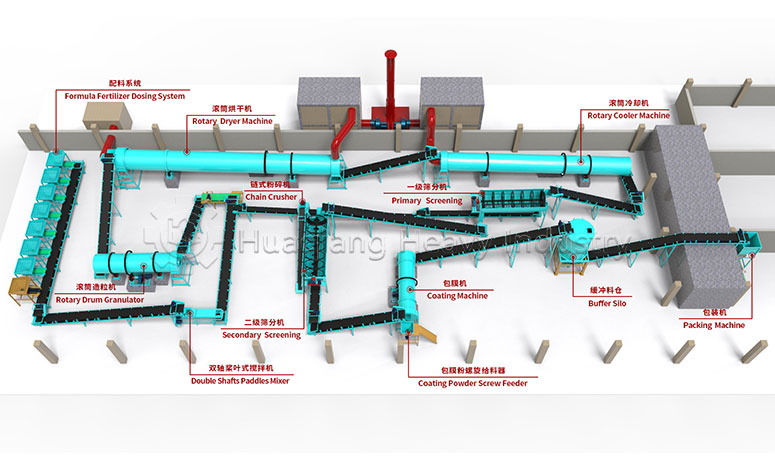
Equipment adaptation and parameter adjustment during granulation are crucial. The rotary drum granulator or flat die pelleting machine of the NPK production line should be prioritized: for rotary drum granulation, adjust the inclination angle to 3°-5°and the rotation speed to 20-30 r/min, and precisely control the moisture content to 15%-18% through spraying; for flat die granulation, adjust the die hole diameter and roller pressure to match the raw material viscosity. Additionally, DAP requires a slight increase in ammoniation to maintain strength, while MAP requires strict control of the conditioning liquid to prevent moisture absorption.
Post-granulation quality verification is essential. The granules must be dried promptly (temperature 80-100℃) and screened to ensure the finished product has a moisture content of ≤2% and a particle size of 2-4.75mm; unqualified granules are returned to the fertilizer mixer machine for reprocessing. Granule strength and nutrient uniformity are monitored throughout the process, and equipment parameters are fine-tuned to ensure consistent quality.